
Built to Win, Still Searching: Inside Panathinaikos’ Lineup Dilemma
What the Numbers Reveal About Panathinaikos’ Unfinished Puzzle


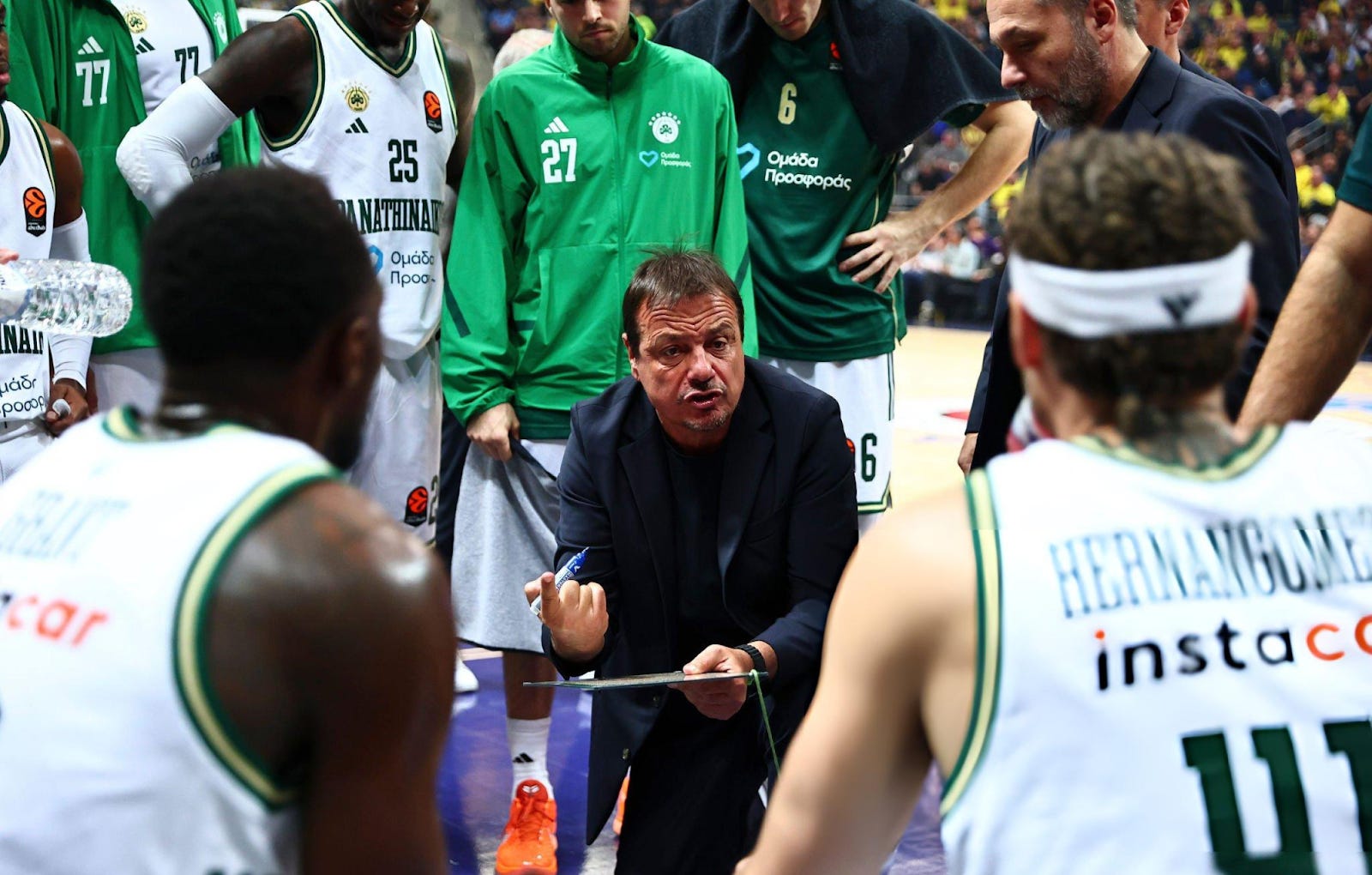
Panathinaikos entered the season with one clear ambition: build a European dynasty. The summer reflected that intent. TJ Shorts arrived fresh off an MVP-caliber year in Paris. Richaun Holmes was signed after the club explored Jonas Valanciunas. Greek firepower was added in Rogkavopoulos and Toliopoulos, while mid-season the Greens doubled down with NBA veteran Kenneth Faried. On paper, it is arguably the most offensively gifted roster in the EuroLeague.
Yet basketball is rarely won on paper. With Mathias Lessort sidelined and roles still in flux, Panathinaikos has struggled to consistently impose themselves despite clear stretches of high-level play. The numbers suggest a team caught between identities: explosive but unstable, deep but imbalanced and with a few defensive holes. To understand why, we need to dig beneath the surface.
A Good Team, Not a Dominant One
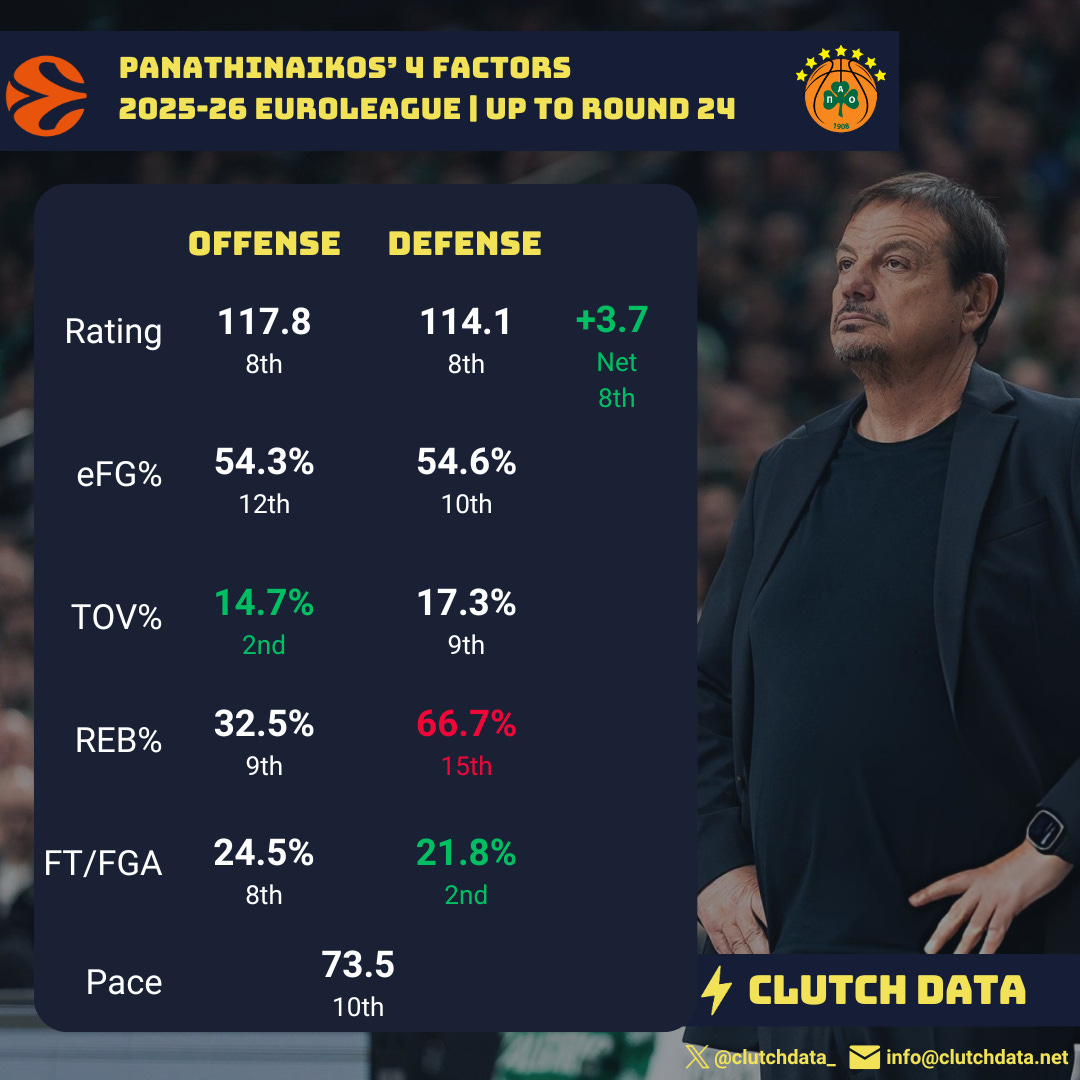
Through Round 24, Panathinaikos ranks 8th in both Offensive and Defensive Rating. They score 117.8 points per 100 possessions while conceding 114.1, resulting in a +3.7 Net Rating, also 8th in the league.
Offensively, efficiency has been middling rather than elite. Their 54.3% effective field goal percentage ranks 12th, while their offensive rebounding rate sits at 32.5% (9th). They do get to the free throw line slightly more often than average (24.5% FT/FGA, 8th) and, importantly, they protect the ball well, with just 14.7% of possessions ending in turnovers.
Defensively, the profile is mixed. Panathinaikos excels at limiting free throws, allowing opponents to generate just 21.8% FT/FGA (2nd-best). However, they struggle on the glass, securing only about two-thirds of available defensive rebounds (15th). Opponents shoot 54.6% eFG% against them (10th), while PAO forces turnovers on 17.3% of defensive possessions.
The 3-Guard System Revisited
Ergin Ataman’s preference for three-guard lineups is well established, dating back to his Anadolu Efes days. At Panathinaikos, he now has three of the league’s most accomplished guards in Kendrick Nunn, Kostas Sloukas, and TJ Shorts, supported by Jerian Grant.
Offensively, the fit is logical. Sloukas and Shorts are natural orchestrators who can both create for others and themselves, while Nunn can thrive as an off-ball scorer who can seamlessly shift into isolation-heavy roles. Defensively, however, the equation becomes more fragile. Shorts and Sloukas, in particular, can be targeted, raising questions about lineup balance.
Kendrick Nunn as the Offensive Accelerator
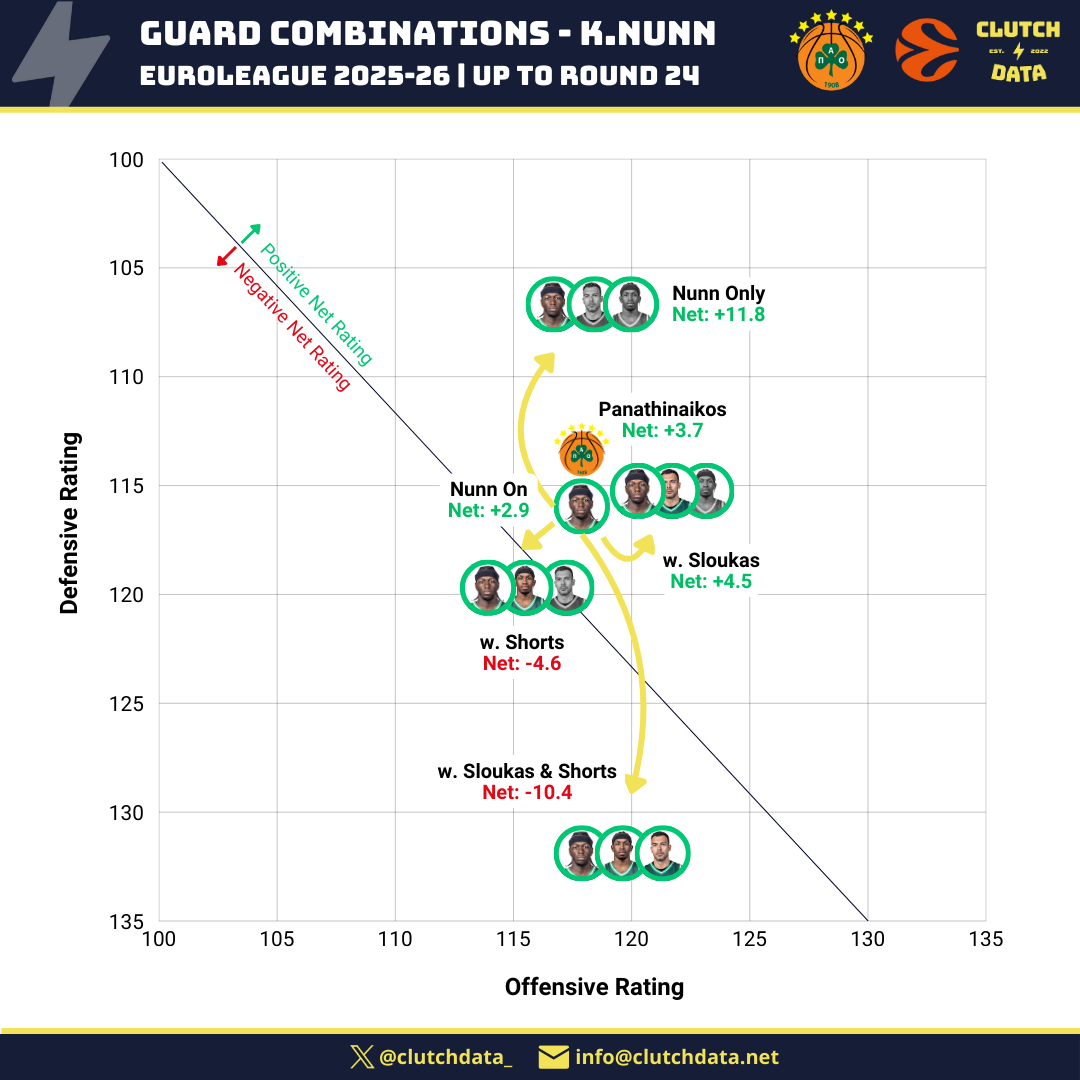
When Kendrick Nunn is on the floor, irrespective of teammates, Panathinakos has a +2.9 Net Rating. This number jumps to +11.8 when Nunn is not sharing the floor with neither Sloukas nor Shorts and surprisingly this is because of increased Defensive efficiency, with the Defensive Rating dropping to 106.7. When accompanied by Sloukas, the team’s Net Rating is still positive at +4.5 points per 100 possessions. Things deteriorate when Shorts is added to the mix - Nunn together with Shorts and without Sloukas leads to a -4.6 Net Rating. And when all 3 play together we have the lowest Net Rating at -10.4.
With Kendrick Nunn on the floor, Panathinaikos posts a +2.9 Net Rating regardless of lineup. That figure spikes dramatically to +11.8 when Nunn plays without either Sloukas or Shorts, surprisingly driven primarily by a defensive improvement that drops the Defensive Rating to 106.7.
When paired with Sloukas, the Net Rating remains positive at +4.5. The picture changes sharply with Shorts. Nunn alongside Shorts (without Sloukas) produces a -4.6 Net Rating, while lineups featuring all three guards sink to a very low -10.4 Net Rating, mainly due to an abysmal defensive execution.
Sloukas, the Stabilizer
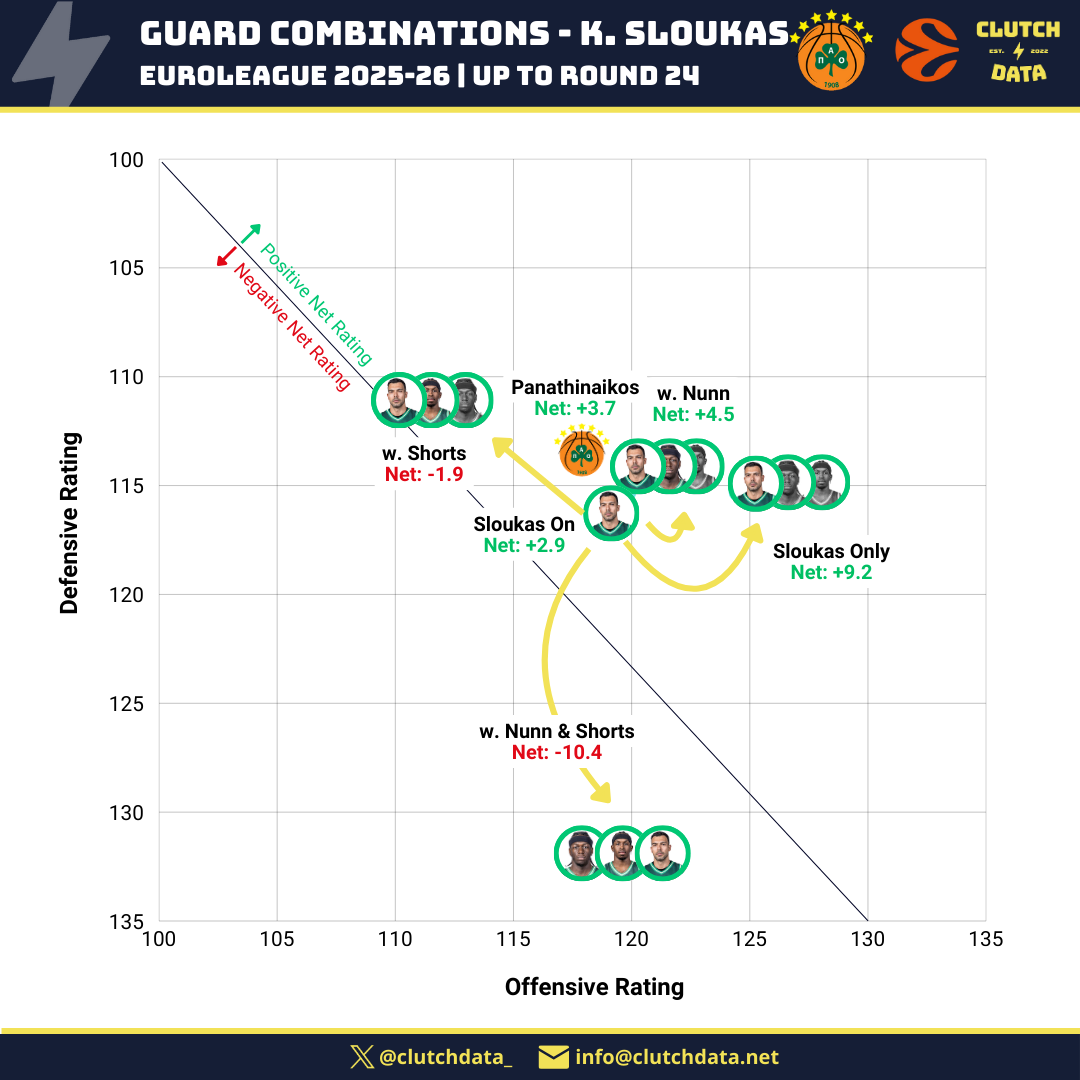
Sloukas mirrors Nunn’s overall impact in raw numbers, with Panathinaikos again posting a +2.9 Net Rating when he is on the floor. Offense improves slightly, defense slips marginally.
The pairing with Nunn once again yields positive returns (+4.5 Net Rating). When Sloukas operates alone, the offense flourishes, reaching 124.5 points per 100 possessions and producing a +9.2 Offensive Rating. Yet, as with Nunn, adding Shorts tilts the balance negatively, resulting in a -1.9 Net Rating.
Two Guards, Two Identities
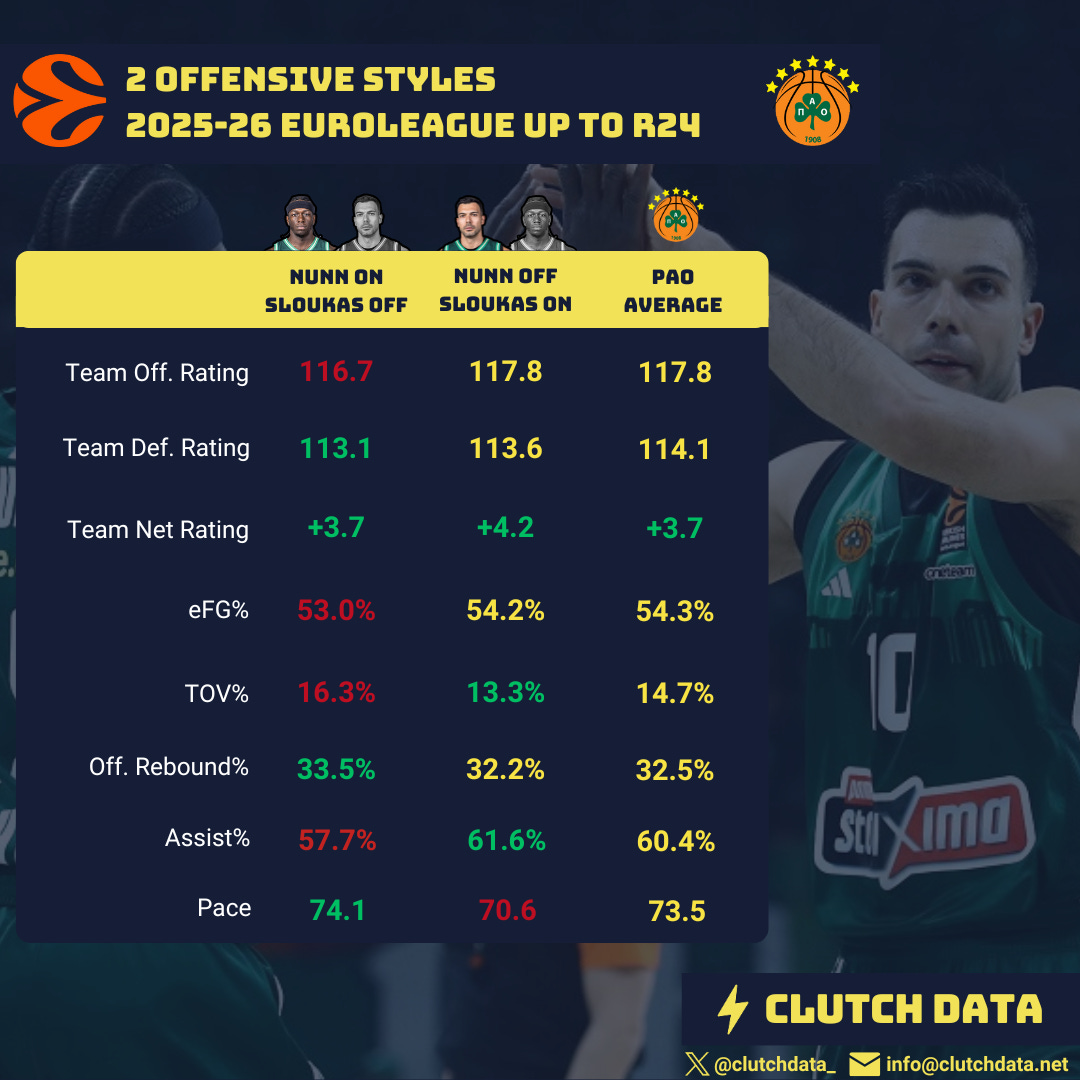
While both Sloukas and Nunn drive positive results, they do so in fundamentally different ways. It’s evident that the team has 2 distinct offensive styles when each one is on the floor. Sloukas is an elite playmaker and facilitator and can make everyone around him better. With Sloukas on the floor and Nunn off, Panathinaikos maintains its offensive output while improving defensively. Ball security improves (13.3% TOV%), and 61.6% of baskets are assisted. The trade-off is pace, which slows considerably.
With Nunn on and Sloukas off, the team shifts gears. Pace jumps to 74.1 possessions per game, turnovers increase (16.3% TOV%), and assisted baskets drop to 57.7%. Shooting efficiency dips slightly (53.0% eFG%), but increased possessions and offensive rebounding help compensate.
Playtype Contrast Tells the Story
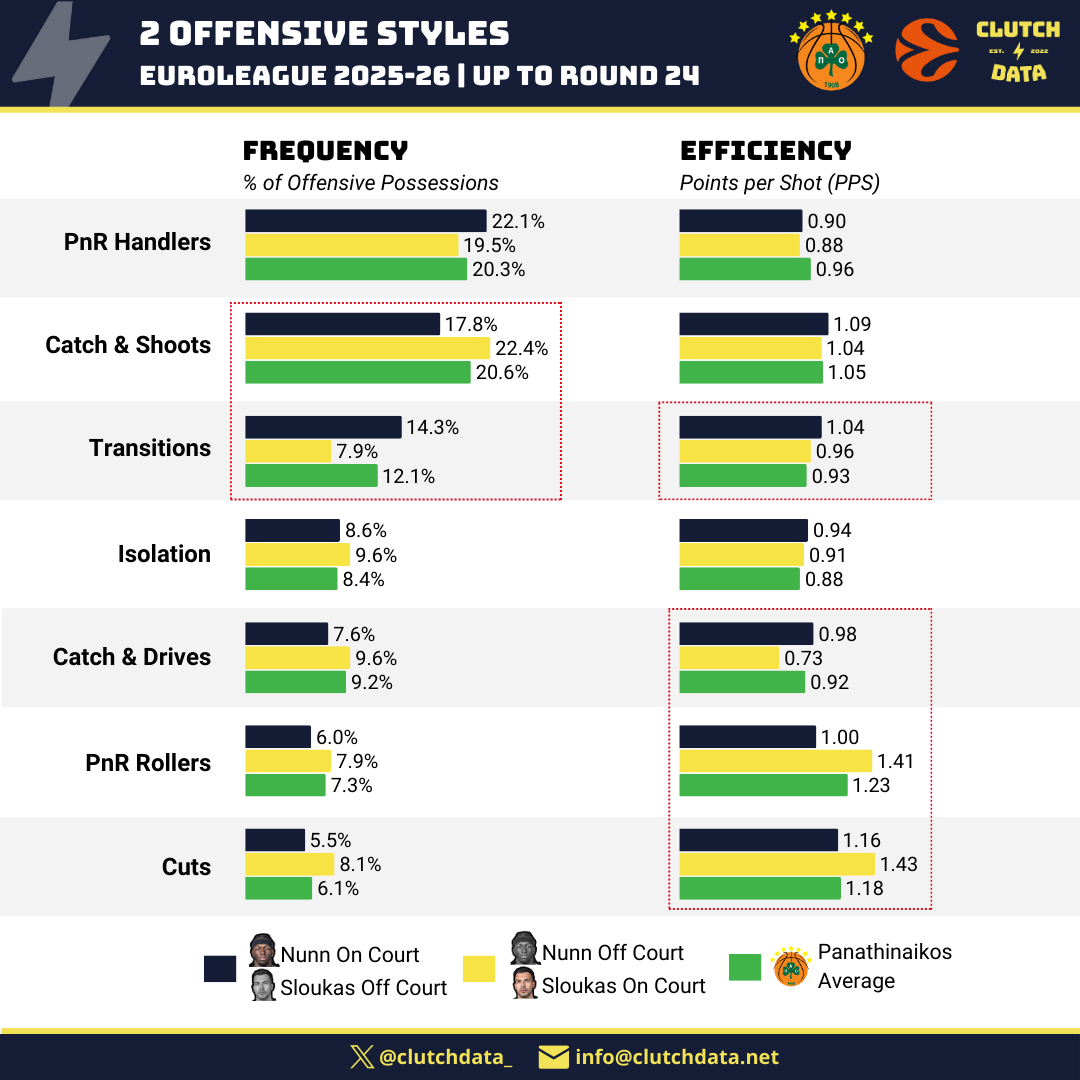
The stylistic divide becomes clearer through playtypes. With Nunn on the court, 14.3% of possessions come in transition, a +6.4 percentage point jump compared to Sloukas-led lineups. Pick & Roll Handler usage also increases.
With Sloukas, the offense flows differently. Ball movement becomes central, with higher frequencies of Catch & Shoot (+4.6pp), Catch & Drive (+2.0pp), and Cut actions (+2.6pp). Bigs are more involved as Rollers.
Efficiency, however, does not always follow volume. Pick & Roll Handler, Catch & Shoot, and Catch & Drive actions fall below league-average efficiency. Where the team truly benefits is in transition with Nunn (1.04 PPS, +8.3%) and in Pick & Roll Roller (1.41 PPS, +41%) and Cut actions (1.43 PPS, +23%) with Sloukas.
The Elephant in the Room
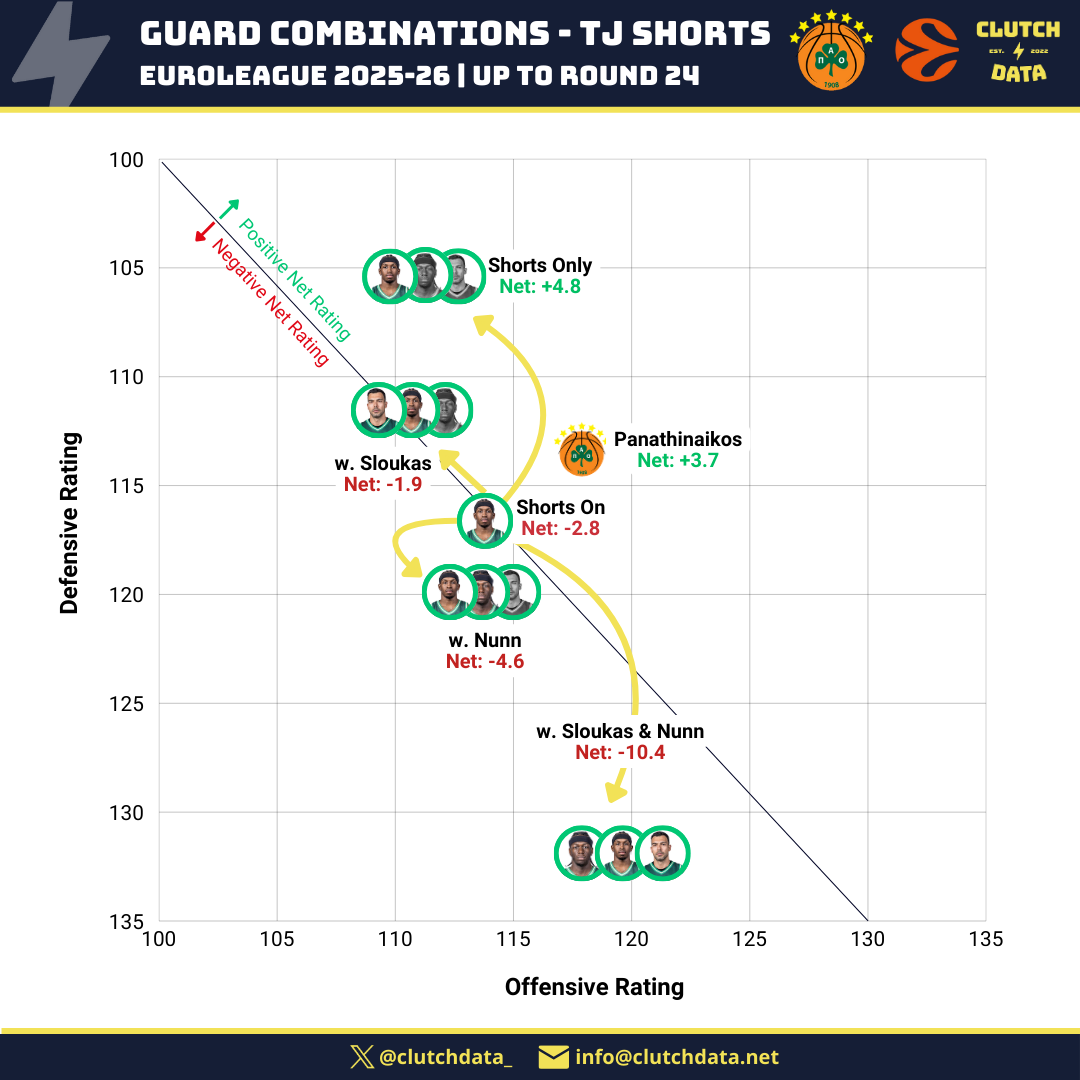
There has been a lot of discussion about the integration of TJ Shorts into the team with many observers fearing a 2024-25 Lorenzo Brown scenario. Together with Sloukas, Panathinaikos posts a -1.9 Net Rating; with Nunn, -4.6. In fact, under nearly all lineup conditions, Shorts’ minutes correlate with a negative overall impact, as the team records a -2.8 Net Rating when he is on the floor.
The exception comes when Shorts operates alone, where the Net Rating flips to a positive +4.8. The data suggests that coexistence, not individual quality, is the core issue.
Offensive Slippage with Shorts
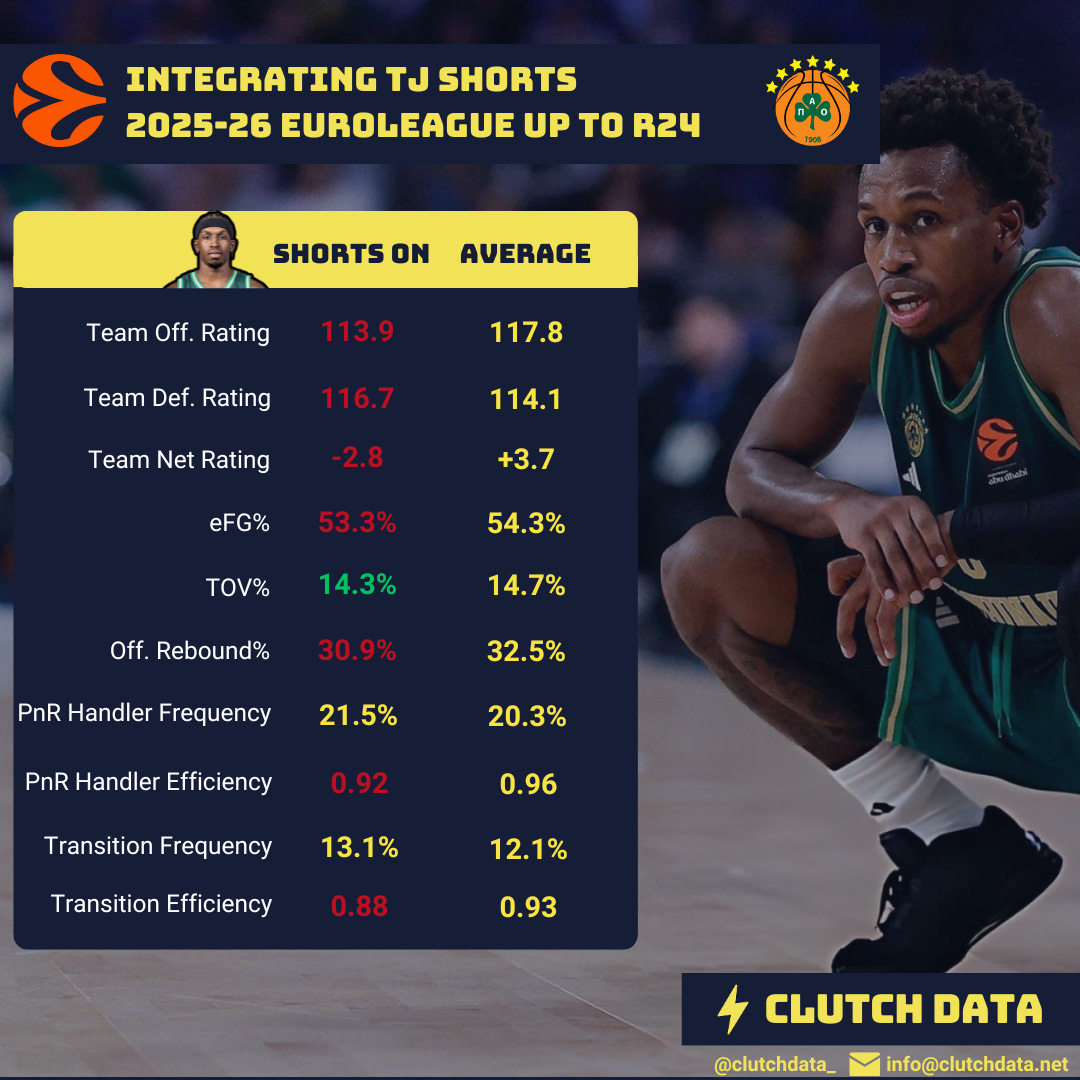
Across the board, lineups featuring Shorts see declines. Offensive Rating drops by 3.9 points per 100 possessions, while Defensive Rating worsens by 2.6, producing a -6.5 Net Rating swing. Shooting efficiency and offensive rebounding both decline. Possessions skew further toward Pick & Roll Handler actions and transition, but without the efficiency required to sustain them. Is there a light at the end of the tunnel?
Recreating the Right Ecosystem
The question surrounding TJ Shorts has never been about talent. His 2024–25 season in Paris settled that debate decisively, as he delivered elite production night after night in a system tailored to his strengths. The real issue in Athens is context: whether the environment around Shorts allows him to unlock that same impact. It’s difficult to draw comparisons between 2 different teams, with 2 different coaches and 2 very different playing styles but some patterns are made obvious. Last year, Shorts was surrounded by a specific group of players that allowed him to unravel his offensive potential while at the same time supporting him on Defense.
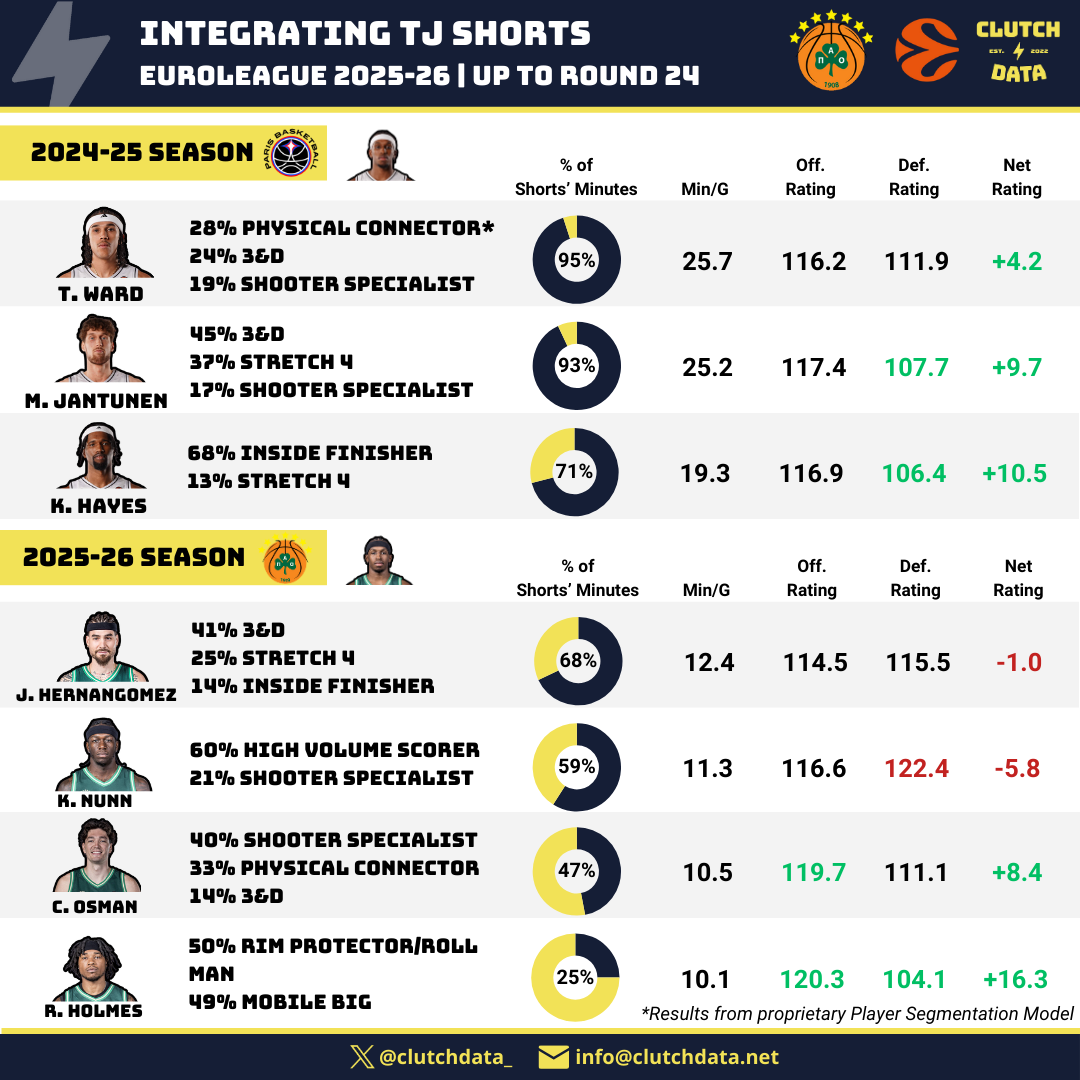
Last season in Paris, Shorts operated within a very specific ecosystem. He played the vast majority of his minutes alongside Tyson Ward, Mikael Jantunen, and Kevarrius Hayes - players who complemented him on both ends of the floor. Ward functioned as a two-way connector who defended, cut, and spaced. Jantunen provided size, shooting, and defensive reliability as a floor-spacing big. Hayes offered vertical gravity as a rim-running finisher and interior defender. Together, they absorbed defensive pressure, amplified Shorts’ playmaking, and covered for his limitations.
At Panathinaikos, the landscape is different. Shorts shares most of his minutes with Juancho (68%), Nunn (59%), Osman (47%), and Holmes (25%). The lineup data shows just how sensitive his impact is to context and we can already see the potential for Shorts to be the best version of himself as when he shares the court with players with similar characteristics as his teammates from last year:
With Osman (profile closest to Tyson Ward): Panathinaikos posts a strong +8.4 Net Rating, driven mainly by offensive efficiency. Osman’s two-way connector role helps cover defensive gaps while keeping the floor functional.
With Holmes (closest parallel to Kevarrius Hayes): the Net Rating jumps to an impressive +16.3, supported by solid offense and excellent defense. Holmes provides rim finishing and interior presence similar to what Shorts had in Paris.
However, the minutes he shares with both of them are quite limited, especially compared to last year
With Juancho, who partially mirrors Jantunen’s floor-spacing profile, the results are mixed. Despite being Shorts’ most frequent partner, their shared minutes result in a -1.0 Net Rating, suggesting a fit that is workable but not yet optimized.
On the other hand, when he shares the court with a ball dominant player such as Nunn, the results are quite bad, especially on the defensive side, with Panathinaikos conceding 122.4 points per 100 possessions, leading to a -5.8 Net Rating
The takeaway is clear: Shorts thrives when surrounded by defenders, connectors, and vertical threats. Replicating the ecosystem that unlocked his elite production in Paris remains the central challenge for Panathinaikos.
Defensive Cracks Without Lessort
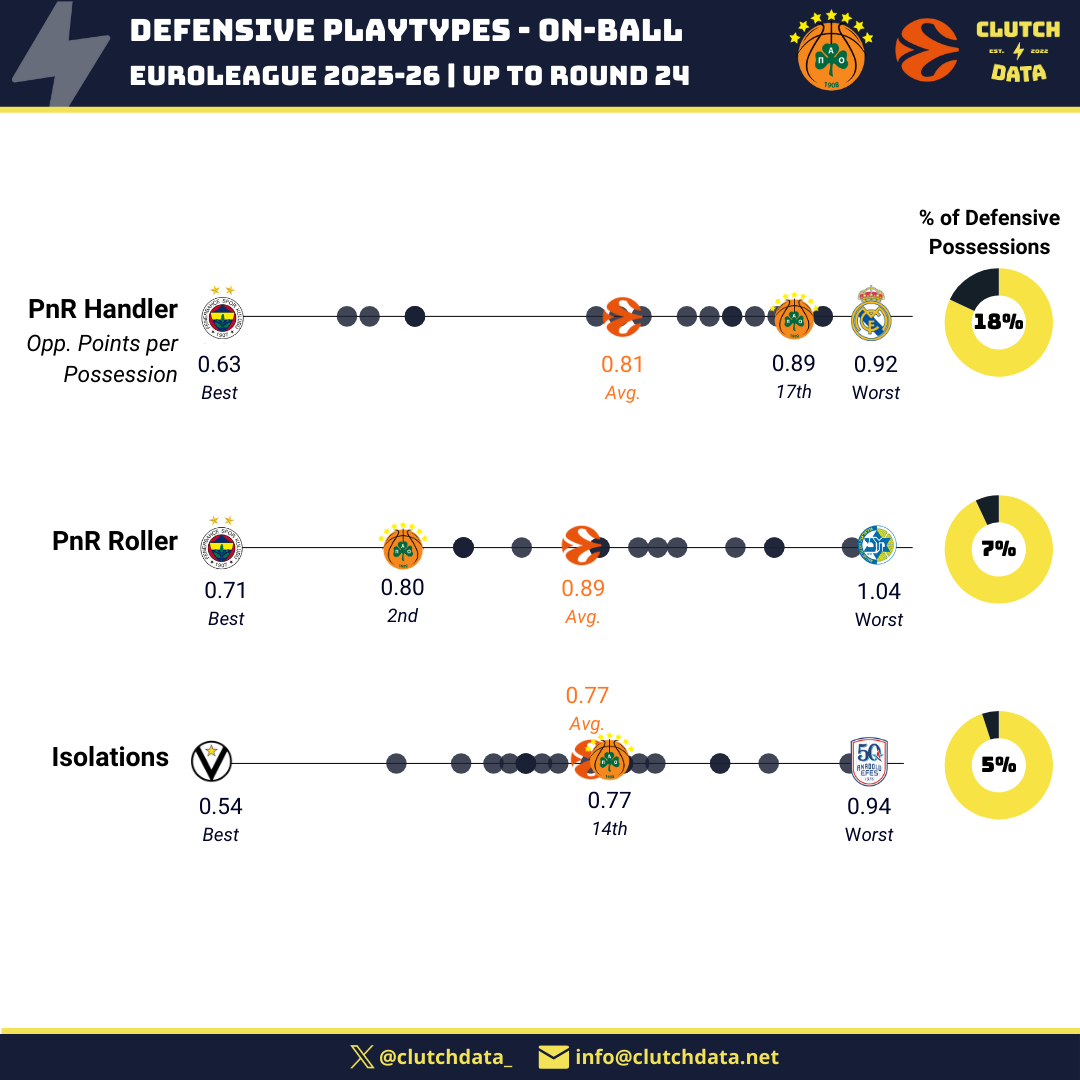
Let’s take a look at the other side of the court. As we mentioned, Panathinaikos’ offensive potential based on their roster is immense. However some questions still remain on defense, especially with Mathias Lessort being sidelined. The team is ranked near the bottom of the league on multiple play types. When it comes to On-ball defense the team is ranked 17th in Pick & Roll Handler defense with their opponents scoring 0.89 Points per Possession (PPP) and this is an action that PAO faces in 18% of their defensive Possessions. On the other hand, the team is ranked 2nd-best in terms of Pick & Roll Roller actions (0.80 PPP allowed) and is below average in Isolations ranking 14th (0.77 PPP allowed).
Personnel Matters on the Ball
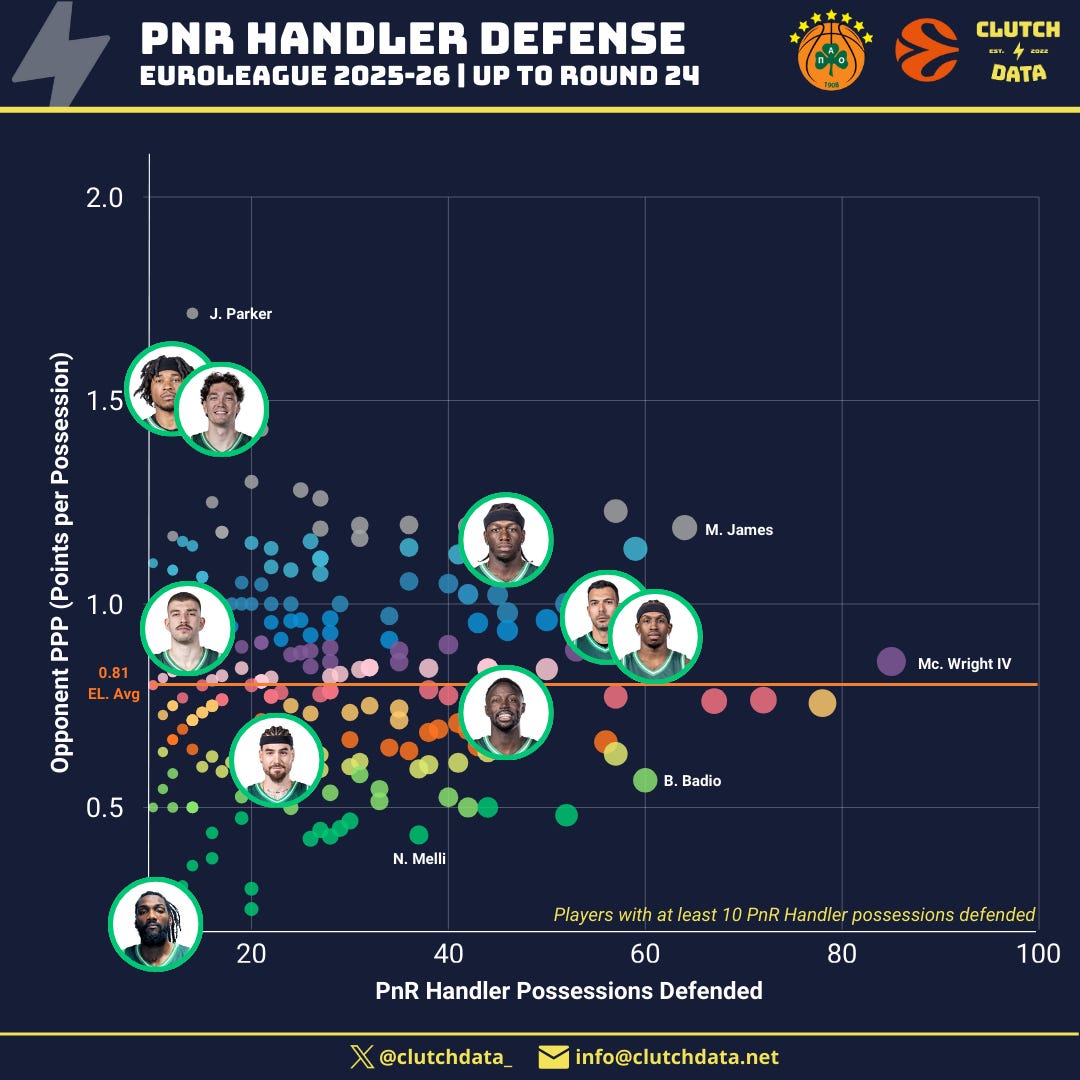
Most guards and wings struggle defending Pick & Roll Handlers. Jerian Grant stands out positively (0.76 PPP). Among bigs, Juancho (0.60 PPP) and Faried (0.20 PPP, limited sample) perform well after switches.
Off-Ball Defense Remains an Issue
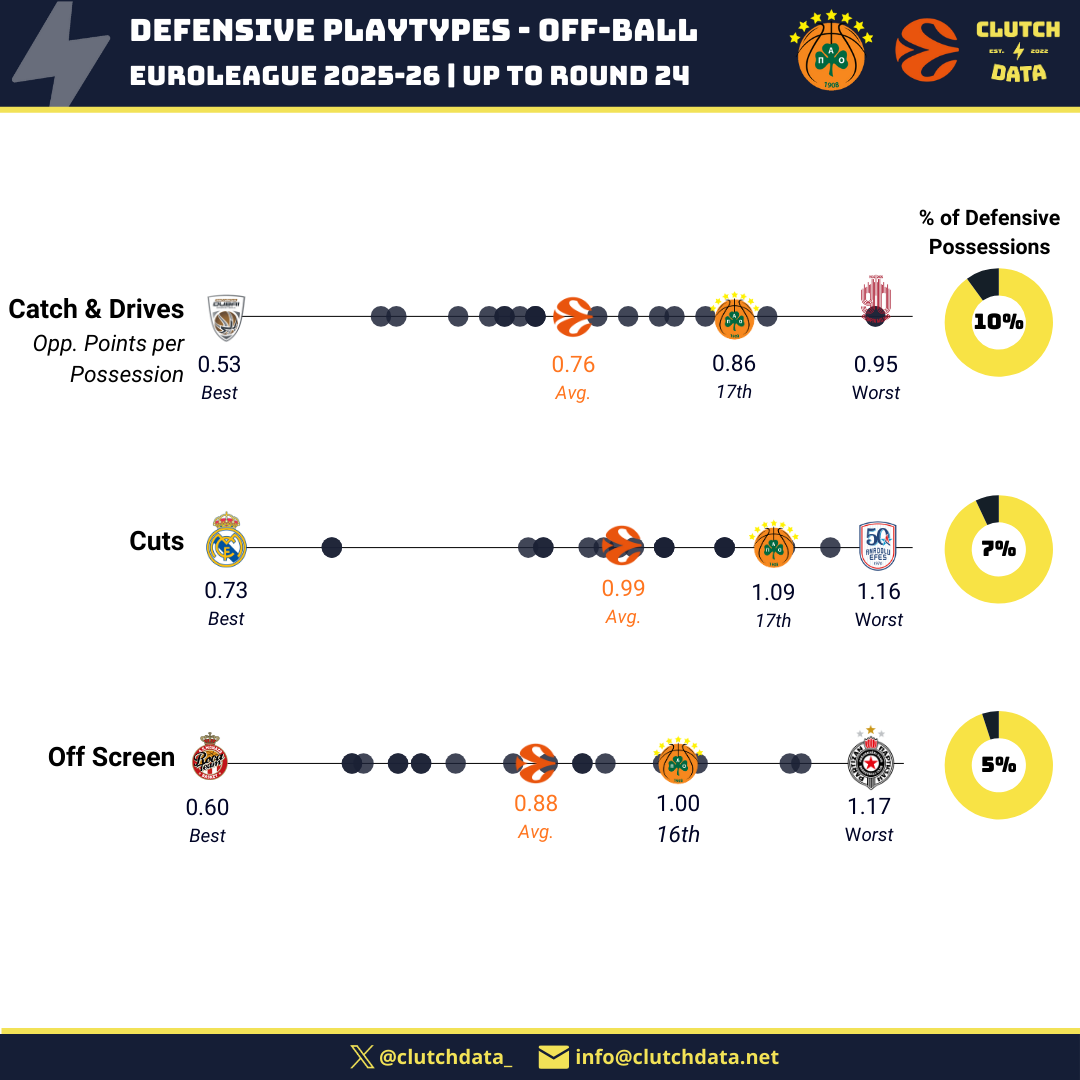
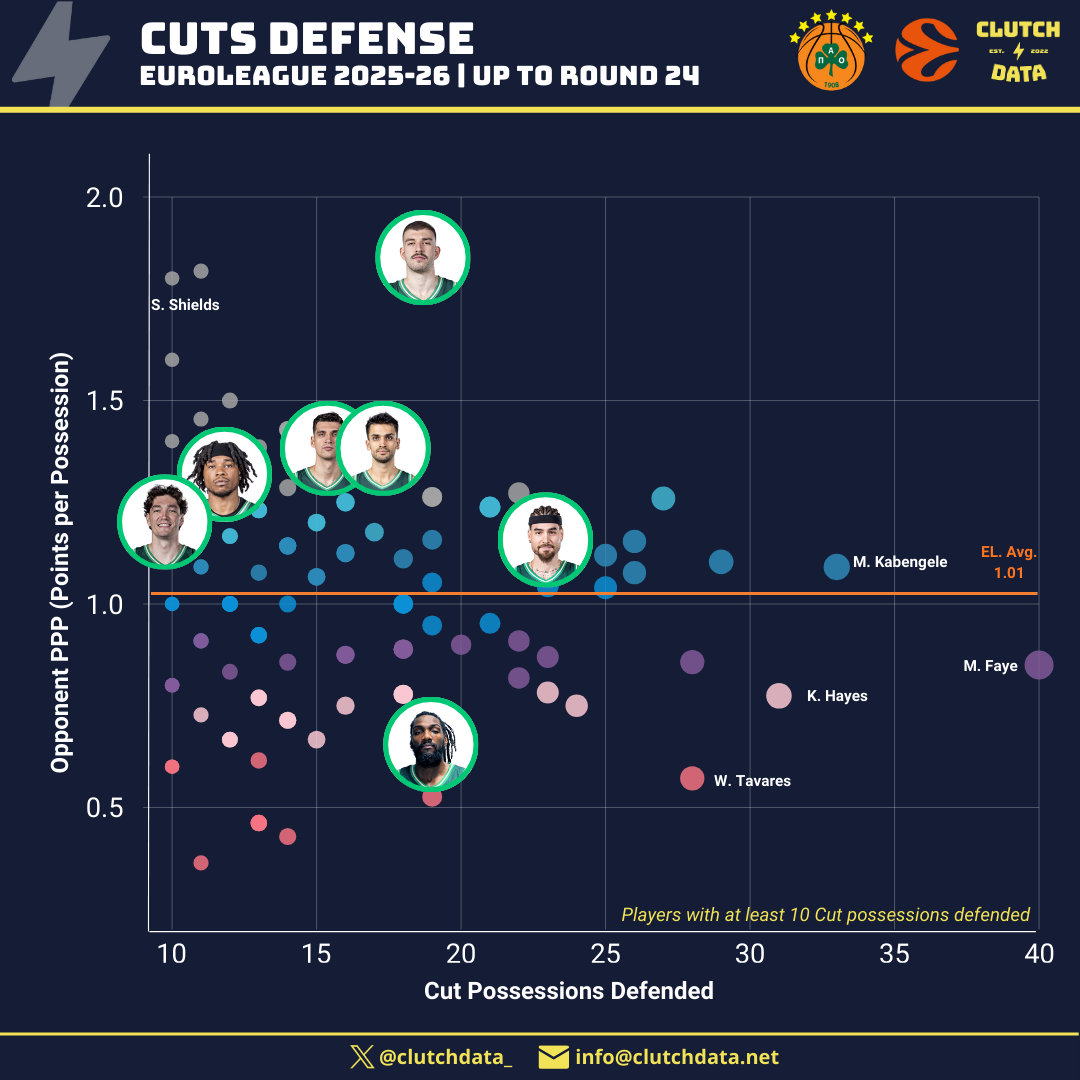
When the defense is forced to rotate and scramble, Panathinaikos falters. They rank 17th in Catch & Drives (0.86 PPP), 17th in Cuts (1.09 PPP), and 16th in Off-Screen actions (1.00 PPP).
Individual Responsibility Is Blurred
Faried is the only player who allows fewer-than-average points on Cuts (0.63 PPP). Still, off-ball defense is inherently collective, with different players trying to cover for the defensive mistakes of their teammates, making it difficult to isolate blame or reward. As we’re going to see below, team defense deteriorates significantly with Faried on the floor.
The Center Rotation Dilemma
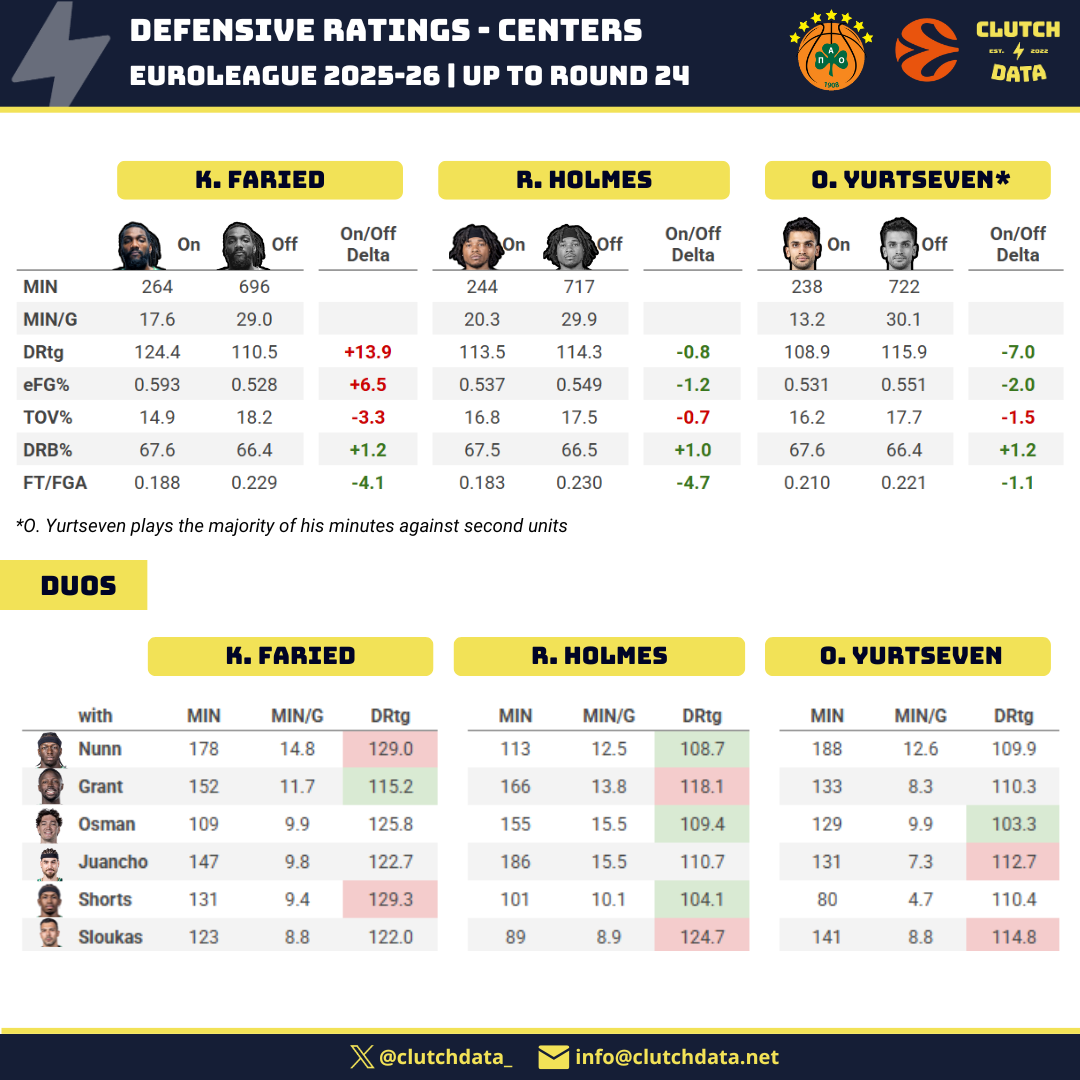
Let’s zoom in on the defensive situation at the Center spot:
With Faried on the court, Panathinaikos defense is extremely weak, allowing 124.4 points per 100 possessions, 13.9 points more than with Faried on the Bench, driven by +6.5pp opponent eFG% and fewer forced turnovers (-3.3pp)
With Holmes on the floor the team stands at a slightly better Defensive Rating aided by lower eFG% of their opponents
And with Yurtseven on the floor, the team is much better on defense but it is worth noting that Yurtseven largely plays against second units
Is there a way to build up on this and improve? Pairings offer partial solutions and help clarify where defensive stability can be found:
Faried + Grant: Defensive Rating improves to 115.2, masking some of Faried’s individual weaknesses through Grant’s on-ball pressure and positioning.
Holmes paired with Nunn (108.8), Osman (109.4), or Shorts (104.1)
Yurtseven + Osman: The most stable pairing, producing an excellent 103.3 Defensive Rating, though largely in minutes against opposing second units.
Guard Defense and the Right Fits
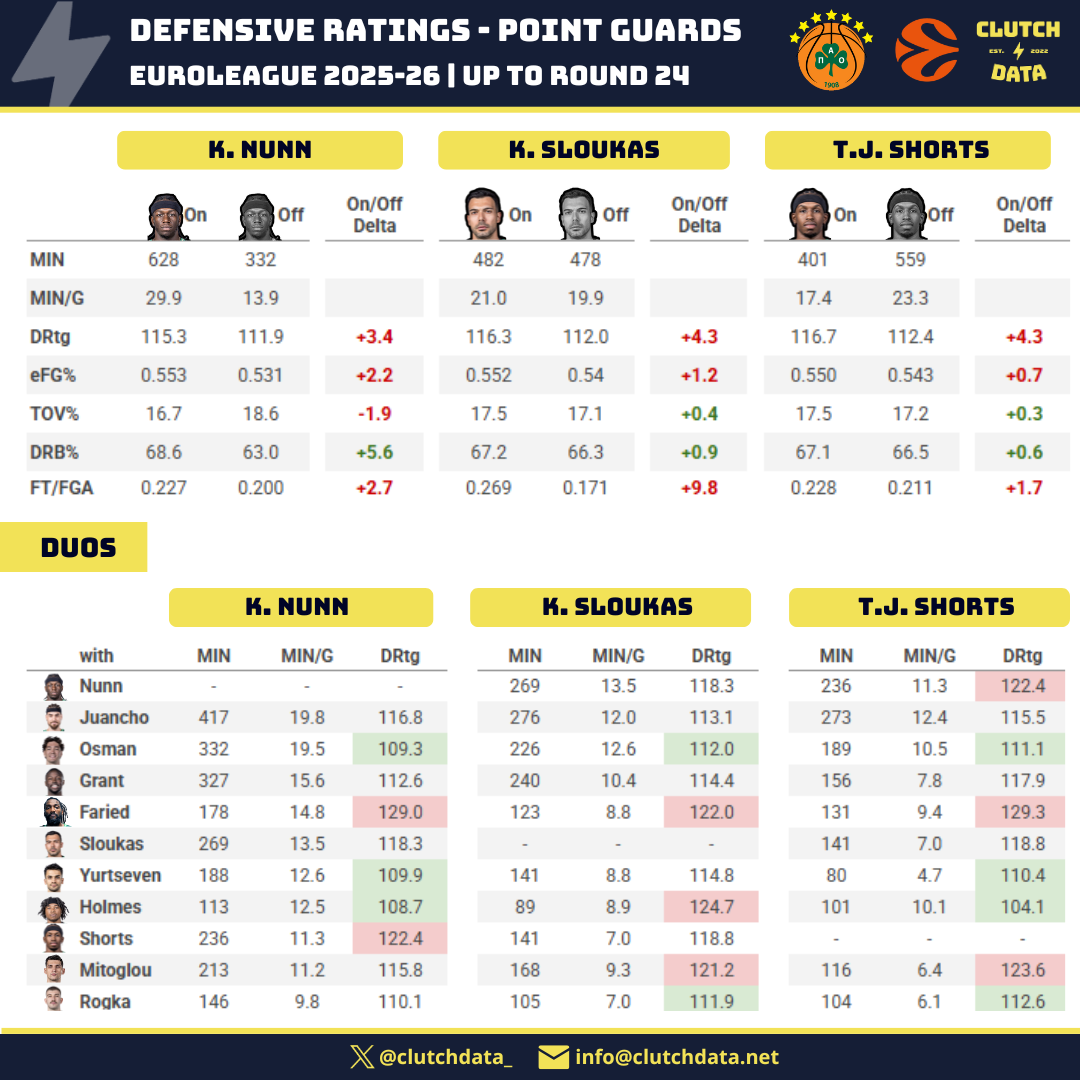
At the point of attack, Panathinaikos faces clear defensive challenges. All three primary guards negatively affect the team’s defensive efficiency when evaluated in isolation:
Kendrick Nunn worsens the Defensive Rating by +3.4 points per 100 possessions, largely due to improved opponent shooting percentages.
Kostas Sloukas carries a +4.3 Def. Rating impact, driven primarily by opponents reaching the free-throw line more frequently.
TJ Shorts also posts a +4.3 Def. Rating swing, a result of both higher opponent shooting efficiency and increased free-throw attempts.
However, these individual weaknesses are not uniform across all lineup contexts. Certain pairings significantly mitigate the damage:
Nunn becomes far more viable defensively when paired with Osman, Yurtseven, or Holmes, producing Defensive Ratings of 109.3, 109.9, and 108.7 respectively.
Sloukas benefits most from lineups alongside Osman or Rogkavopoulos, where Defensive Ratings improve to 112.0 and 111.9.
Shorts sees his best defensive results next to Osman (111.1), Yurtseven (110.4), Holmes (104.1), or Rogkavopoulos (112.6).
The implication is clear: guard defense at Panathinaikos is highly context-dependent, and optimal lineup construction can significantly soften individual limitations.
The True Defensive Pillars
When zooming out across all combinations, two players consistently emerge as defensive stabilizers capable of elevating entire lineups: Cedi Osman and Jerian Grant. Building around them and taking advantage of synergies, Panathinaikos can create combinations that can hide their defensive deficiencies. Their versatility, positioning, and ability to cover for teammates’ mistakes allow Panathinaikos to construct units that function on both ends of the floor.
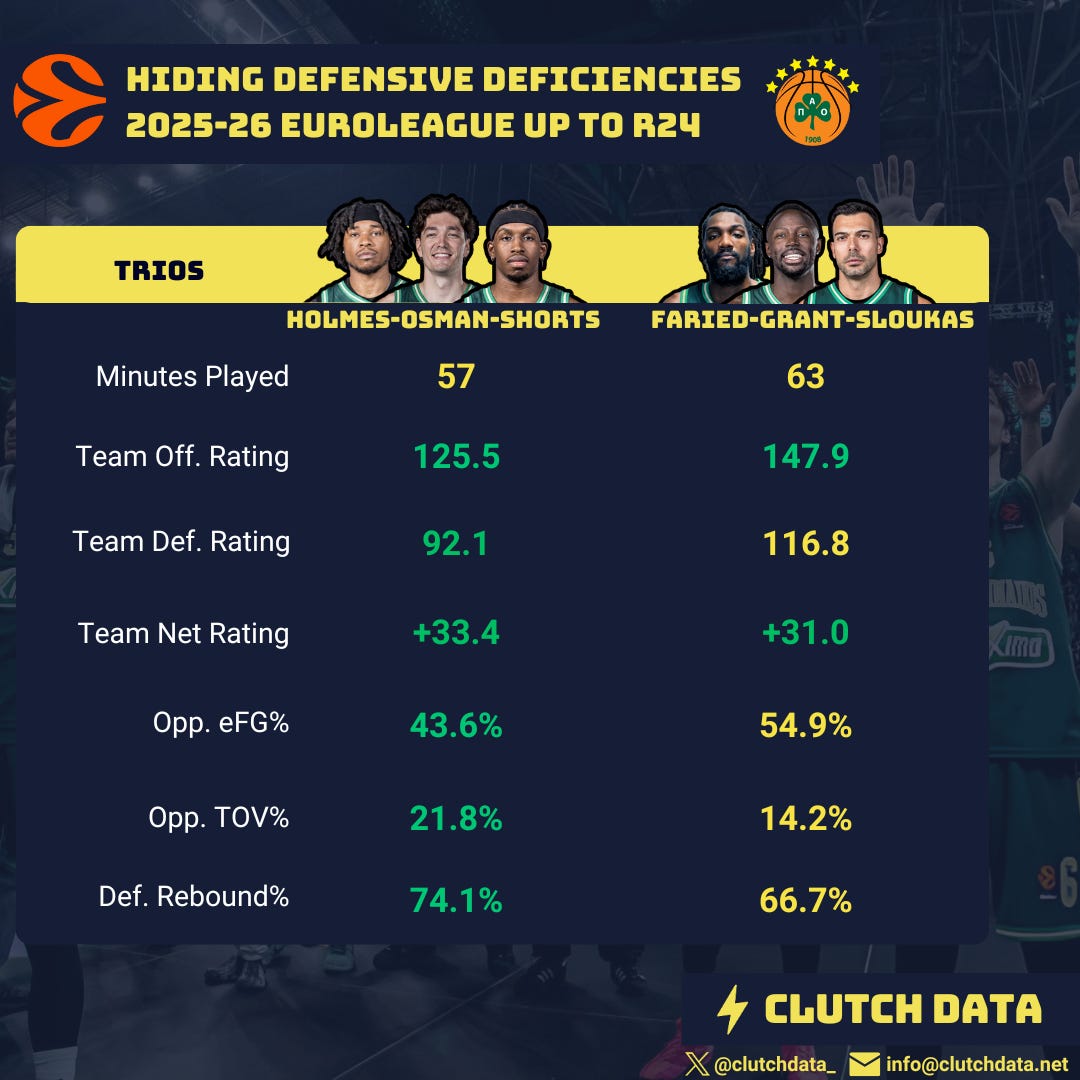
Even though they have played limited minutes together 2 trios stand out:
Holmes – Osman – Shorts: This lineup delivers elite two-way performance, scoring 125.5 points per 100 possessions while allowing just 92.1, resulting in a staggering +33.4 Net Rating. The unit forces turnovers, limits opponent efficiency, and keeps the floor spaced offensively.
Faried - Grant - Sloukas: This combo is masking their average defensive performance by simply outperforming everyone on offense and scoring a mindblowing 147.9 points per 100 possessions
Conclusion: A Puzzle Still Being Solved
Panathinaikos has no shortage of talent. What it lacks—for now—is cohesion. The data points to a team with multiple high-level solutions but few seamless combinations. The path forward lies in role clarity, selective staggering of ball-dominant guards, and leaning into the stabilizing presence of players like Osman and Grant.
If Panathinaikos can align its immense offensive potential with defensively sustainable lineups, the ceiling remains championship-high. Until then, the Greens remain a fascinating case study in how talent alone is never quite enough.
Very thorough and detailed post. Panathinaikos suffers indeed from cohesion and also from the nerves and passion of Ataman. Us fans will be forever grateful to him but he needs to calm down and stop blaming his players all the time. It doesn't help just causes more frustration.