
Barcelona’s Balancing Act
Veteran leadership, tactical adjustments, and the search for a reliable second unit


Barcelona’s season can be understood in two phases: the opening 11 games and the stretch that followed the coaching transition to Xavi Pascual. Rather than representing two completely different teams, the numbers suggest a gradual evolution in emphasis and execution.
Early in the season, Barcelona already showed many of the traits that still define them, strong offensive production, reliable offensive rebounding, and multiple players capable of creating advantages. After the transition, some tactical details shifted: the pace slowed slightly, off-ball actions became more prominent, and defensive shot containment improved.
Beyond tactics, two broader themes have shaped the discussion around the team. Barcelona relies heavily on experienced stars, raising natural questions about the age profile of the core rotation. At the same time, the gap between the primary unit and the secondary rotation has often forced those key players to carry a larger share of the load.
The data therefore points less to a dramatic transformation and more to a process of adjustment. Many structural elements remained intact, while areas such as isolation usage, defensive organization, and lineup balance gradually evolved as the season progressed.
What follows is an attempt to understand those trends through the numbers, what stayed stable, what changed, and how those shifts shaped Barcelona’s performance.
Continuity on Offense Despite the Changes
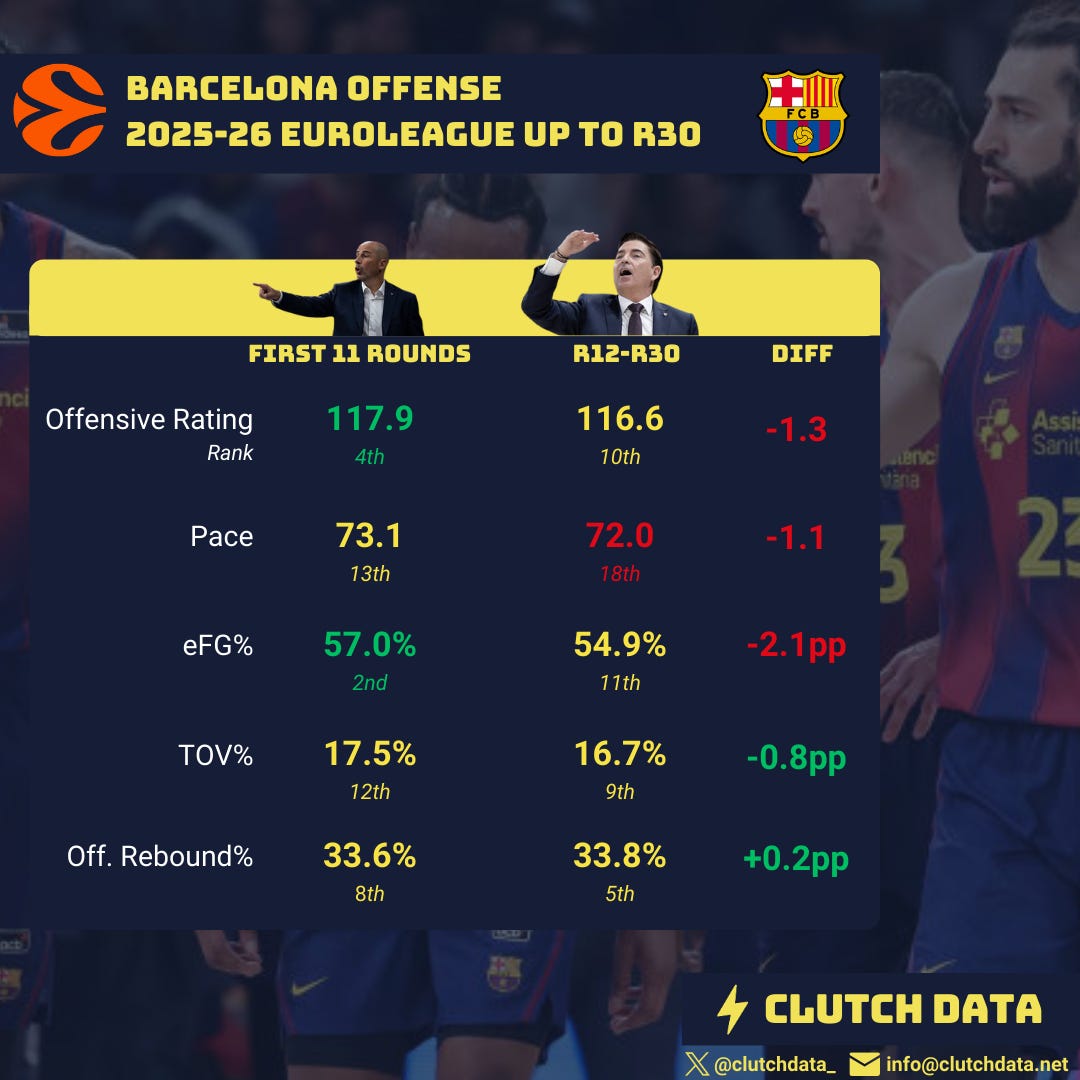
Barcelona opened the season with a highly productive offense. In the first 11 games, the team scored 117.9 points per 100 possessions. After the coaching change, that number declined slightly to 116.6 Offensive Rating, representing only a modest drop in overall scoring efficiency.
The underlying Four Factors reveal that the offensive structure remained largely stable. The most noticeable change appears in shooting efficiency, where the team’s effective field goal percentage (eFG%) declined by 1.1 percentage points. At the same time, Barcelona slightly improved its ball security, lowering its turnover rate by 0.8 percentage points.
Other elements of offensive production have remained almost identical. The team continues to attack the offensive glass at a similar rate and reaches the free-throw line with nearly the same frequency as earlier in the season.
Where the change becomes more visible is in tempo. Since the coaching transition, Barcelona has slowed its pace significantly and now ranks third from the bottom in the EuroLeague in Pace, suggesting a more controlled offensive rhythm.
Defensive Stability and Improved Shot Containment
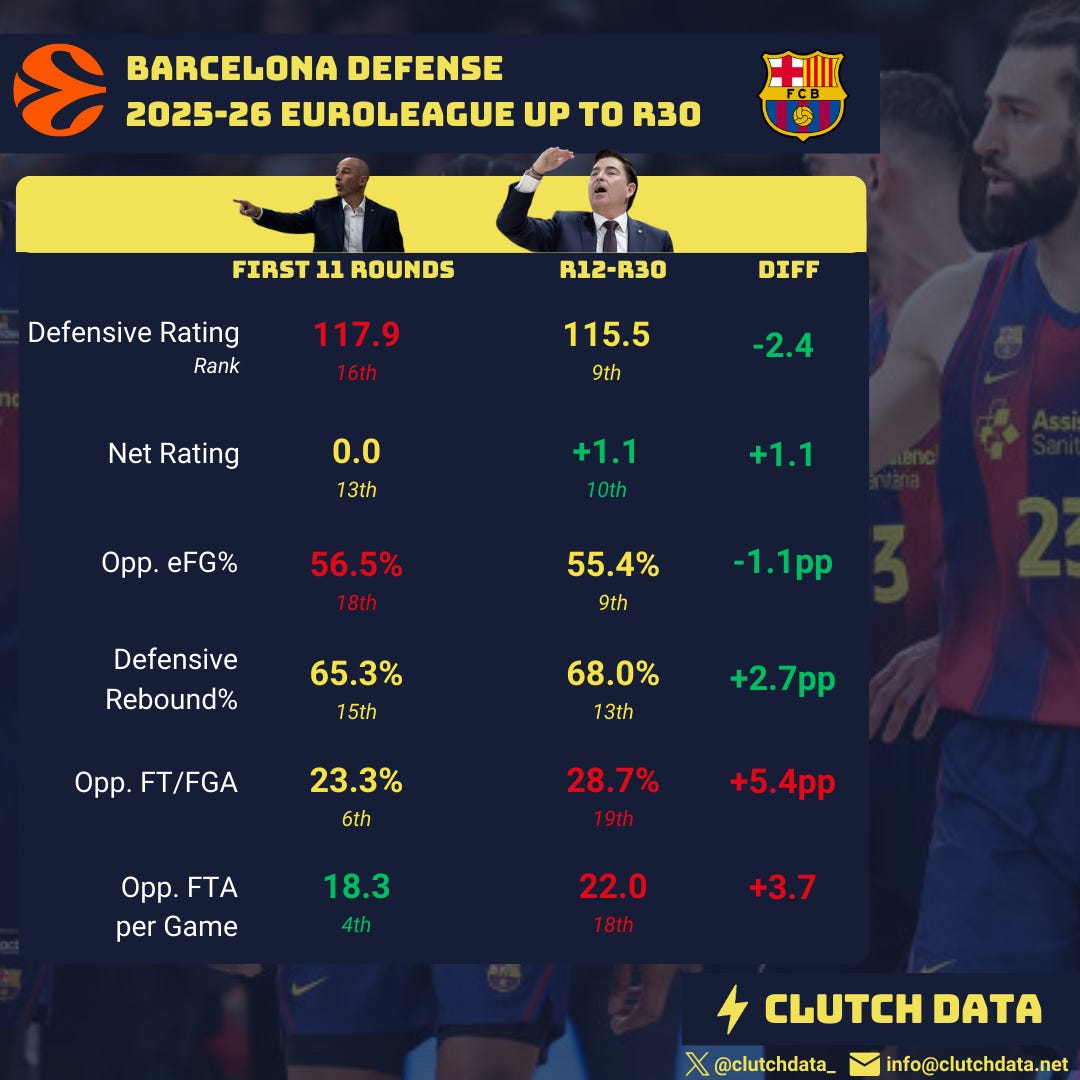
While the offensive changes have been subtle, the defensive side has shown clearer improvement. Barcelona now allows 115.5 points per 100 possessions, producing an overall +1.1 Net Rating during this stretch. Much of this defensive progress stems from improved shot defense. During the first 11 games of the season, opponents posted a 56.5% effective field goal percentage, which ranked 18th in the league at the time. Under Pascual, that number has dropped to 55.3%, improving Barcelona’s ranking to 9th lowest in the competition.
Rebounding has also improved. The team’s Defensive Rebound Percentage increased by 2.7 percentage points, though Barcelona still sits outside the league’s top 10 in that category.
The one defensive drawback has been fouling. Opponents are reaching the free‑throw line more frequently, with the FT/FGA ratio increasing by 5.4 percentage points, translating to roughly four additional free‑throw attempts per game.
A Shift Toward Movement and Off‑Ball Offense
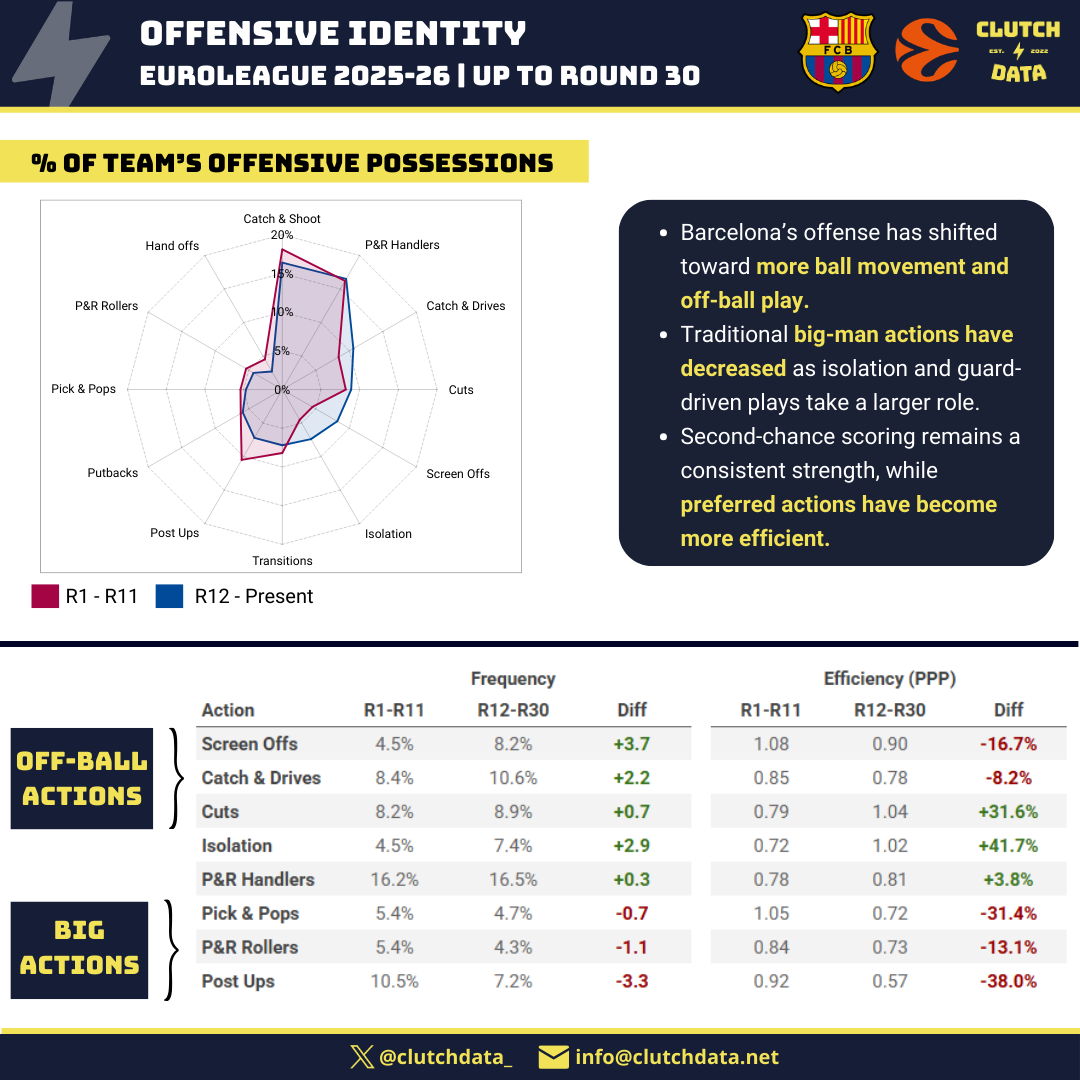
A coaching change often reveals itself through the types of actions a team runs. Under Xavi Pascual, Barcelona’s offensive identity has moved toward greater ball movement and increased off‑ball activity.
Several playtypes have grown in frequency:
Catch & Drives increased by 2.2 percentage points, now representing 10.6% of possessions since the coaching change.
Screen Off actions increased by 3.7 percentage points, reaching 8.2% of possessions.
Cuts increased by 0.7 percentage points, accounting for 8.9% of actions.
Interestingly, Isolations increased by 2.9 percentage points, now making up 7.4% of offensive possessions.
At the same time, the actions that declined are largely those involving traditional big‑man scoring situations:
Post Ups decreased by 3.3 percentage points (7.2% of possessions).
Pick‑and‑Roll Rollers decreased by 1.1 percentage points (4.3%).
Pick & Pops decreased by 0.7 percentage points (4.7%).
Efficiency trends reinforce this shift. The playtypes that lost volume also experienced the sharpest efficiency declines: Post Ups dropped by 38% in PPP, Pick & Pops by 31.4%, and P&R Rollers by 13.1%.
Meanwhile, Barcelona’s preferred actions have become significantly more effective. Isolations jumped to 1.02 points per possession (+41.7%), making Barcelona the best isolation team in the EuroLeague as of Round 30. Pick & Roll Handler efficiency increased to 0.81 PPP (+3.8%), and Cuts improved to 1.04 PPP (+31.6%). Screen Off actions, despite becoming more frequent, have declined in efficiency to 0.90 PPP (-16.7%). One area of consistent strength has been second‑chance scoring. Barcelona ranks 3rd in the EuroLeague in Putback efficiency.
The Rise of Isolation Creators
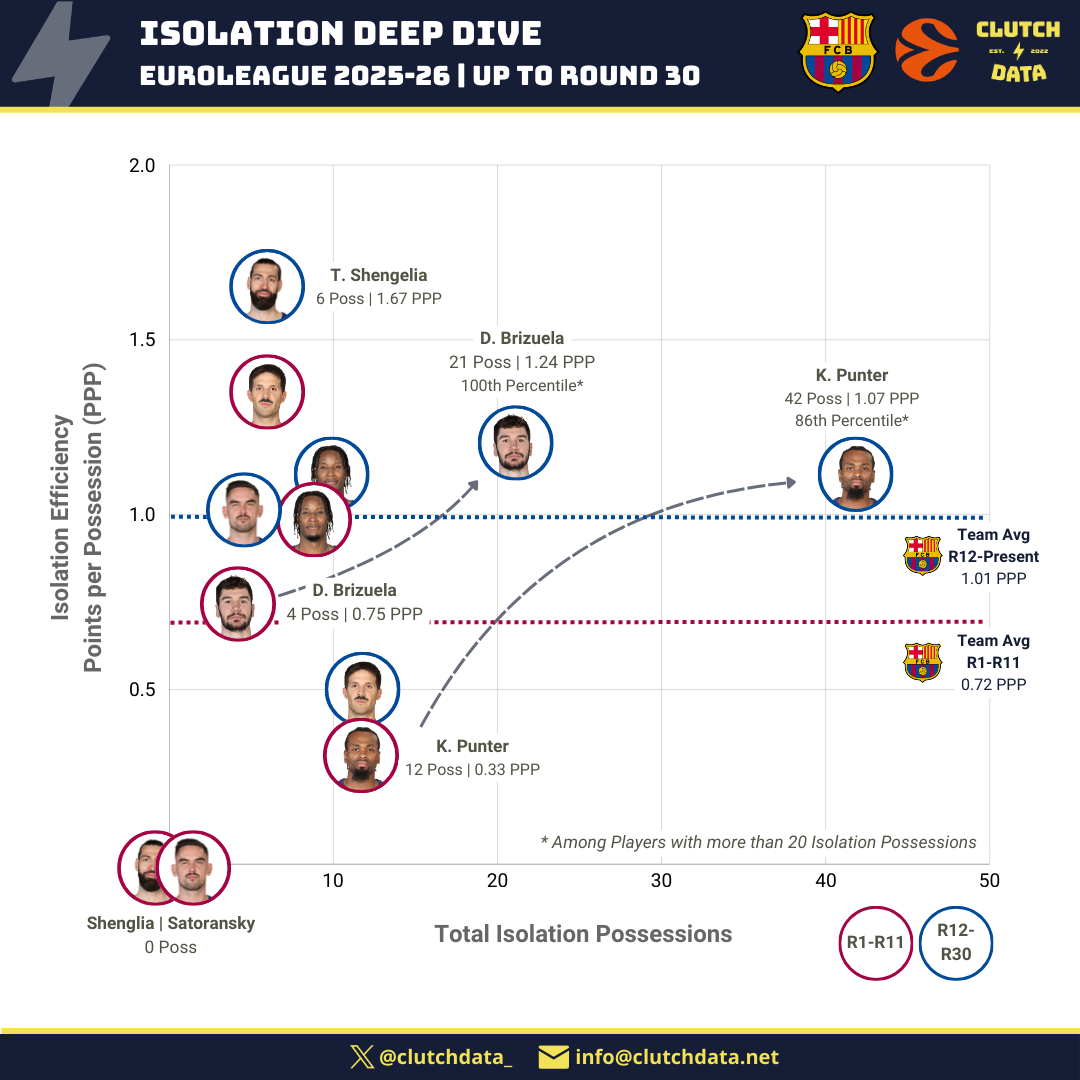
A closer look at the isolation numbers reveals that the increase in frequency is driven primarily by two players: Kevin Punter and Dario Brizuela.
Since Pascual’s arrival, Punter has taken 42 isolation possessions, producing 1.07 points per isolation, which places him in the 86th percentile in the EuroLeague.
Brizuela’s change has been even more dramatic. Before the coaching transition, he had attempted only 4 isolation possessions. Under Pascual, that number has jumped to 21, and his efficiency has been exceptional: 1.24 points per possession, the best mark in the EuroLeague among players with more than 20 isolation possessions.
Barcelona has not simply increased isolation volume, it has empowered specific players to create in situations tailored to their strengths.
Designing Advantages for Kevin Punter
For Kevin Punter, the increase in isolation efficiency is closely tied to how those possessions are created. The offense now does a better job of engineering favorable matchups. Through screens and forced switches, Barcelona often places Punter against defenders he prefers attacking, allowing him to exploit mismatches more consistently.
Just as important is the timing of those isolations. Earlier in the season, most of Punter’s isolations occurred in the final six seconds of the shot clock, functioning primarily as last‑resort solutions. Under Pascual, that pattern has changed. Only about half of Punter’s isolations now occur in the final six seconds, while the rest begin earlier in the shot clock. This shift suggests a deliberate tactical decision: Barcelona is no longer relying on Punter’s isolation ability as an emergency option, but actively designing possessions around it.
Brizuela’s Evolution from Bailout to Weapon
A similar transformation has taken place for Dario Brizuela.Earlier in the season, his isolations were largely situational, typically late‑clock scenarios when the offense needed a difficult shot. Under Pascual, those possessions have become more structured. Barcelona now actively creates isolation opportunities for Brizuela rather than stumbling into them late in possessions.
Another factor behind his efficiency is shot selection. Brizuela has been significantly more effective when attacking the rim rather than settling for jump shots, allowing him to convert isolation opportunities at a far higher rate. Furthermore, he takes advantage of his speed and starts many of his attempts near the Half Court line, getting an advantage over slower defenders.
Offensive Rebounding as a Consistent Advantage
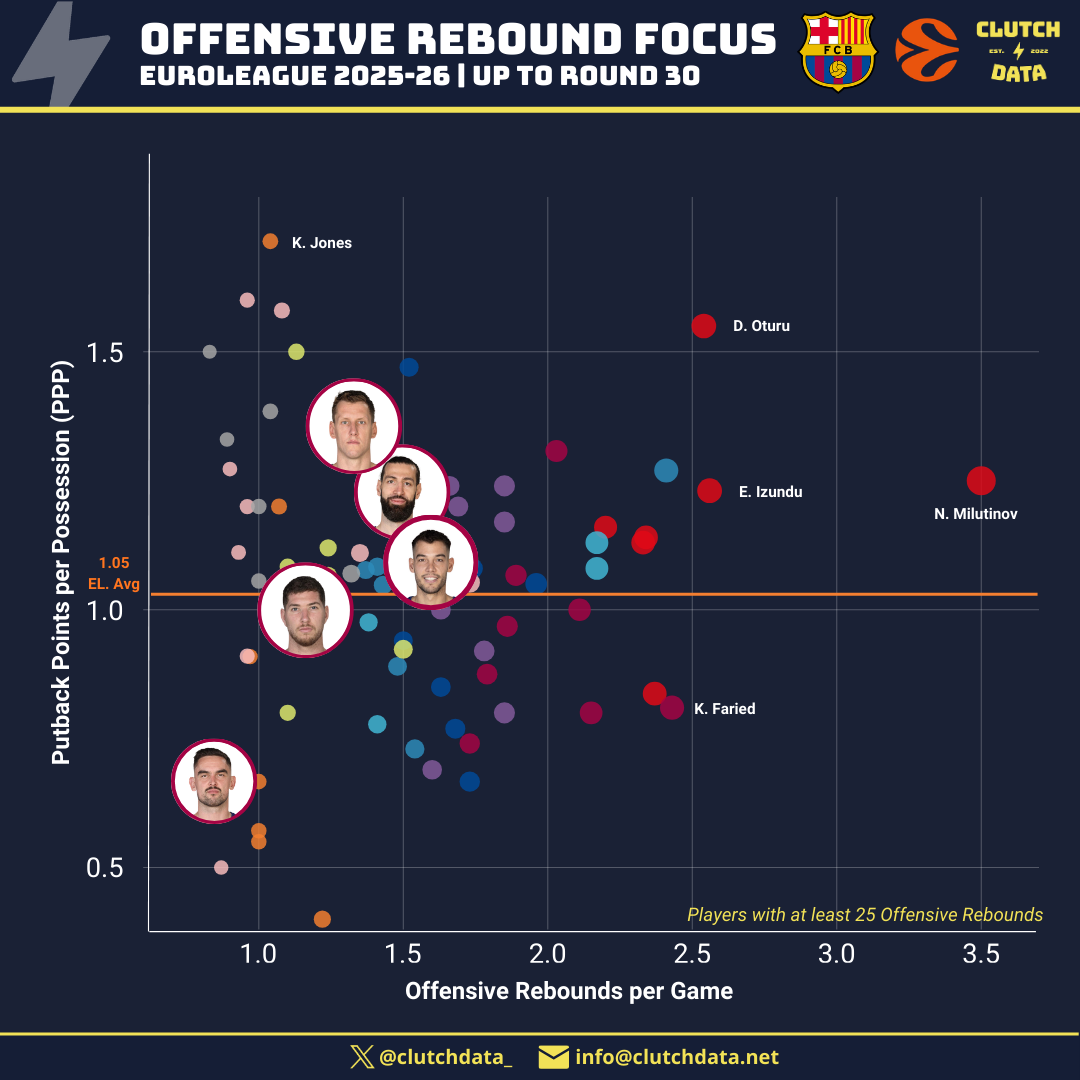
One area where Barcelona has remained strong throughout the season is offensive rebounding and second‑chance scoring. The team has five players with more than 25 offensive rebounds, providing consistent opportunities for putbacks. Among them, several players convert those opportunities at highly efficient rates:
Vesely scores 1.36 PPP on putbacks.
Shengelia converts 1.20 PPP.
Hernangomez adds 1.13 PPP.
Parra contributes 1.00 PPP in those situations.
The only outlier is Satoransky, who produces 0.66 PPP on putbacks.
Overall, Barcelona’s ability to generate and convert second‑chance opportunities remains one of its most reliable offensive strengths.
The Defensive Weak Spot: The Open Floor
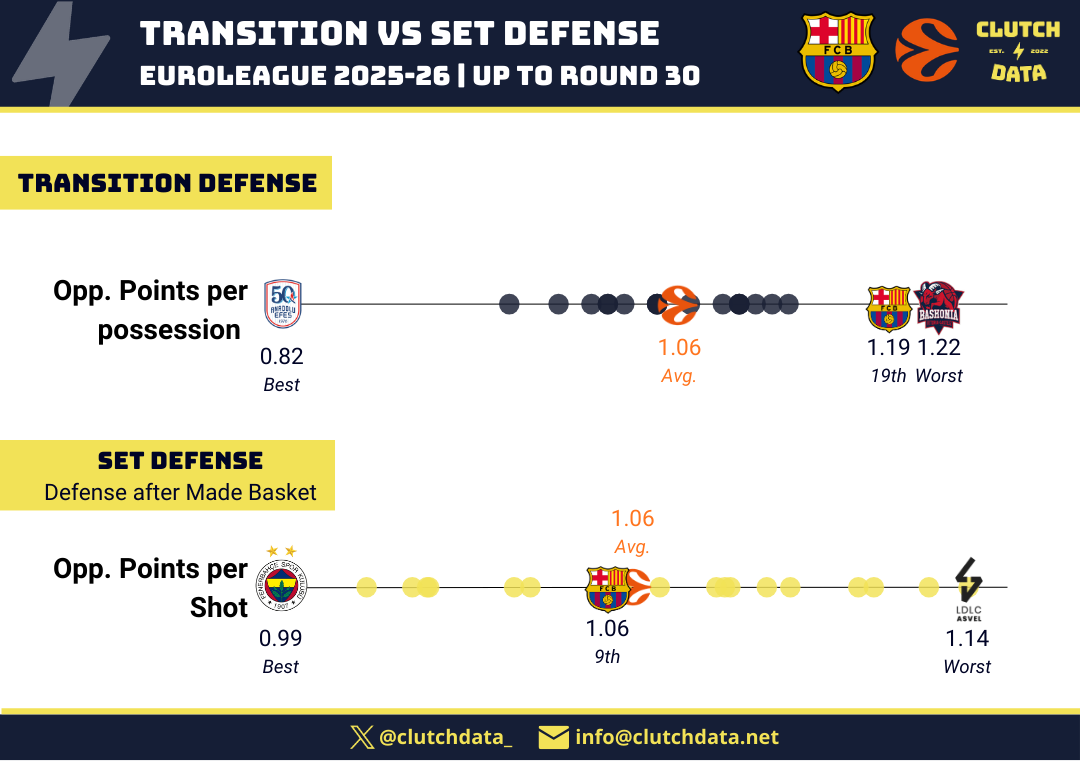
Defensively, Barcelona has struggled all season in transition. The team ranks second from the bottom in the EuroLeague in opponent points per possession in transition, allowing 1.19 PPP while maintaining only an average turnover rate. This weakness places additional pressure on Barcelona’s half‑court defense to stabilize possessions.
Fortunately for the team, its set defense performs considerably better. After made baskets, Barcelona ranks 9th in the EuroLeague, allowing 1.06 points per shot in half‑court situations.
Where the Defense Has Quietly Improved
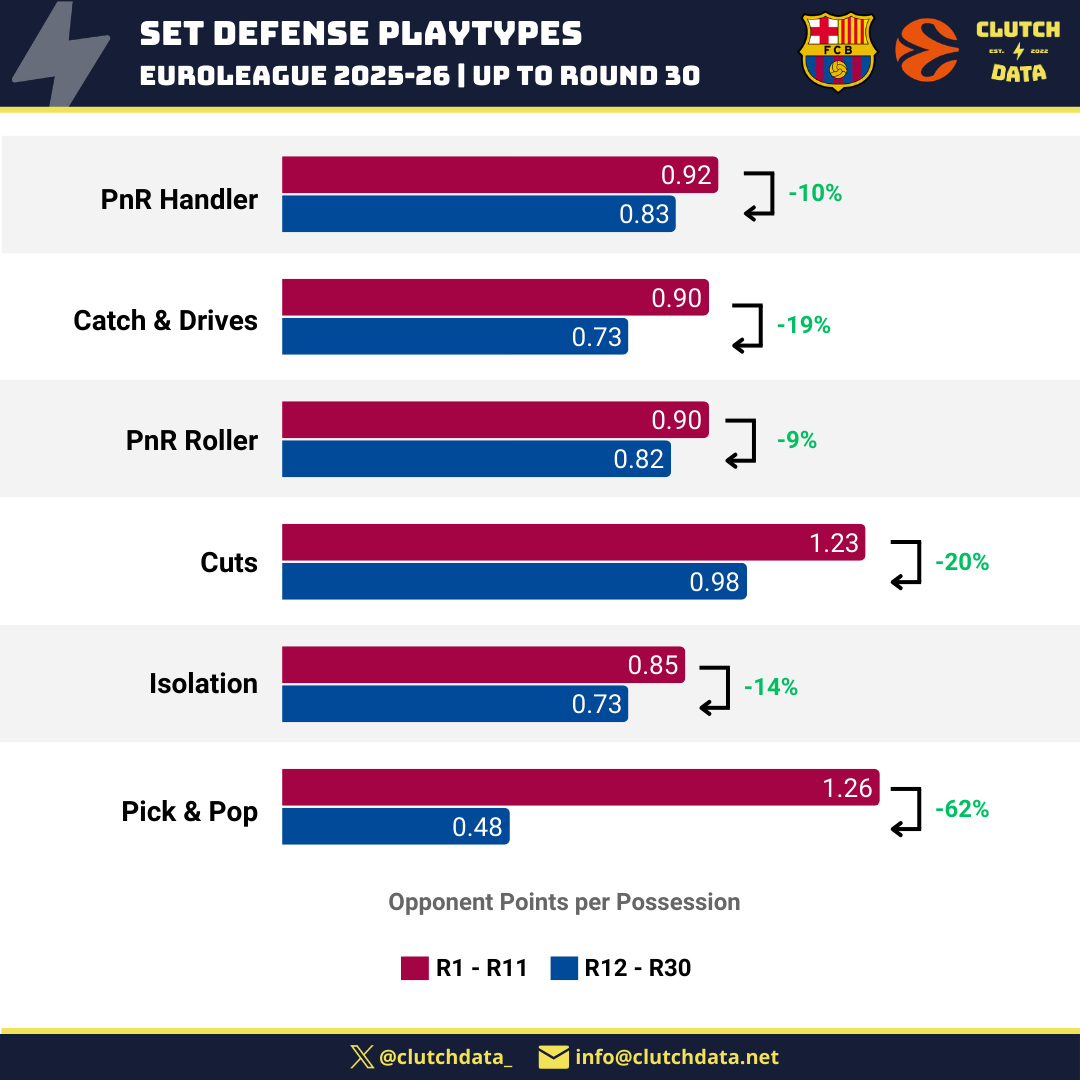
Under Pascual, Barcelona’s defensive improvement is visible across several offensive playtypes used by opponents. The team has reduced opponent efficiency in many of the most common actions:
P&R Handler efficiency decreased by 10%.
Catch & Drives efficiency dropped by 19%.
P&R Roller actions declined by 9%.
Cuts decreased by 20%.
Isolations declined by 14%.
The most dramatic shift appears in Pick & Pop situations, where opponent efficiency has fallen by 62%, though this comes on relatively low volume.
Collectively, these improvements explain the drop in opponent effective field goal percentage and highlight how Barcelona has tightened its defensive execution.
Adjusting Pick‑and‑Roll Coverage
As mentioned earlier, Barcelona has improved its defense against both Pick-and-Roll Handlers and Rollers. Part of that improvement can be traced to small but meaningful adjustments in how the team defends pick-and-roll actions.
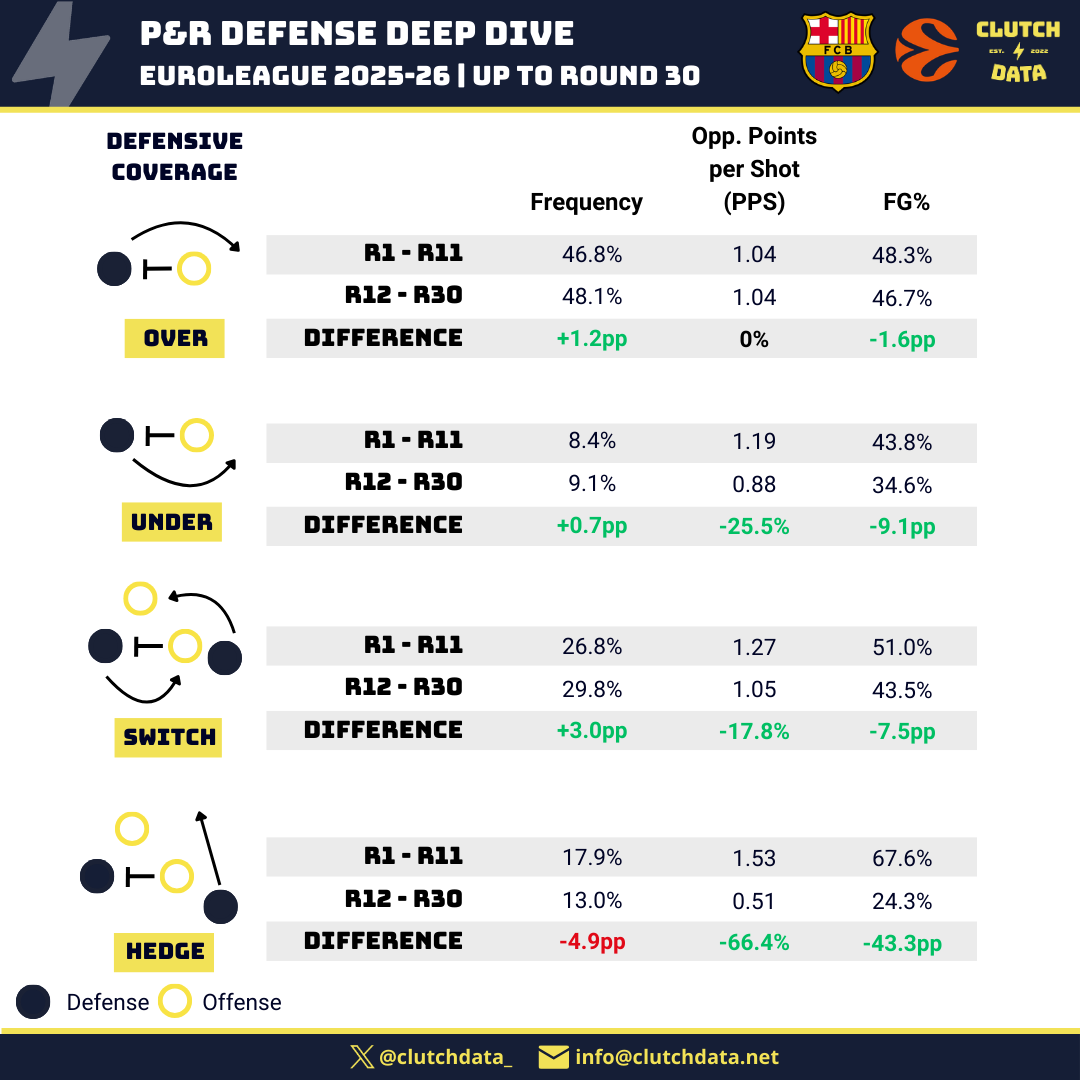
The most notable change is a reduced reliance on Hedging. Barcelona now Hedges almost 5 percentage points less frequently than earlier in the season. Instead, the team has leaned more into Switching, increasing its usage by 3 percentage points. At the same time, Barcelona’s most common pick-and-roll coverage, Over, has remained the foundation of its approach. Not only has it stayed the primary option, but its usage has even increased slightly by 1.2 percentage points.
The efficiency results are encouraging. Opponent Points per Shot have declined across almost every coverage type. When Barcelona goes Under, opponent efficiency drops by 25.5%. When the defense Switches, it falls by 17.8%. And when the team Hedges, opponent efficiency has decreased dramatically by 66.4%. The only coverage where efficiency has remained largely unchanged is Over, where opponent Points per Shot have stayed roughly the same.
Overall, these subtle tactical shifts appear to have strengthened Barcelona’s pick-and-roll defense without requiring a complete overhaul of their scheme.
The Clear Divide Between Starters and the Bench
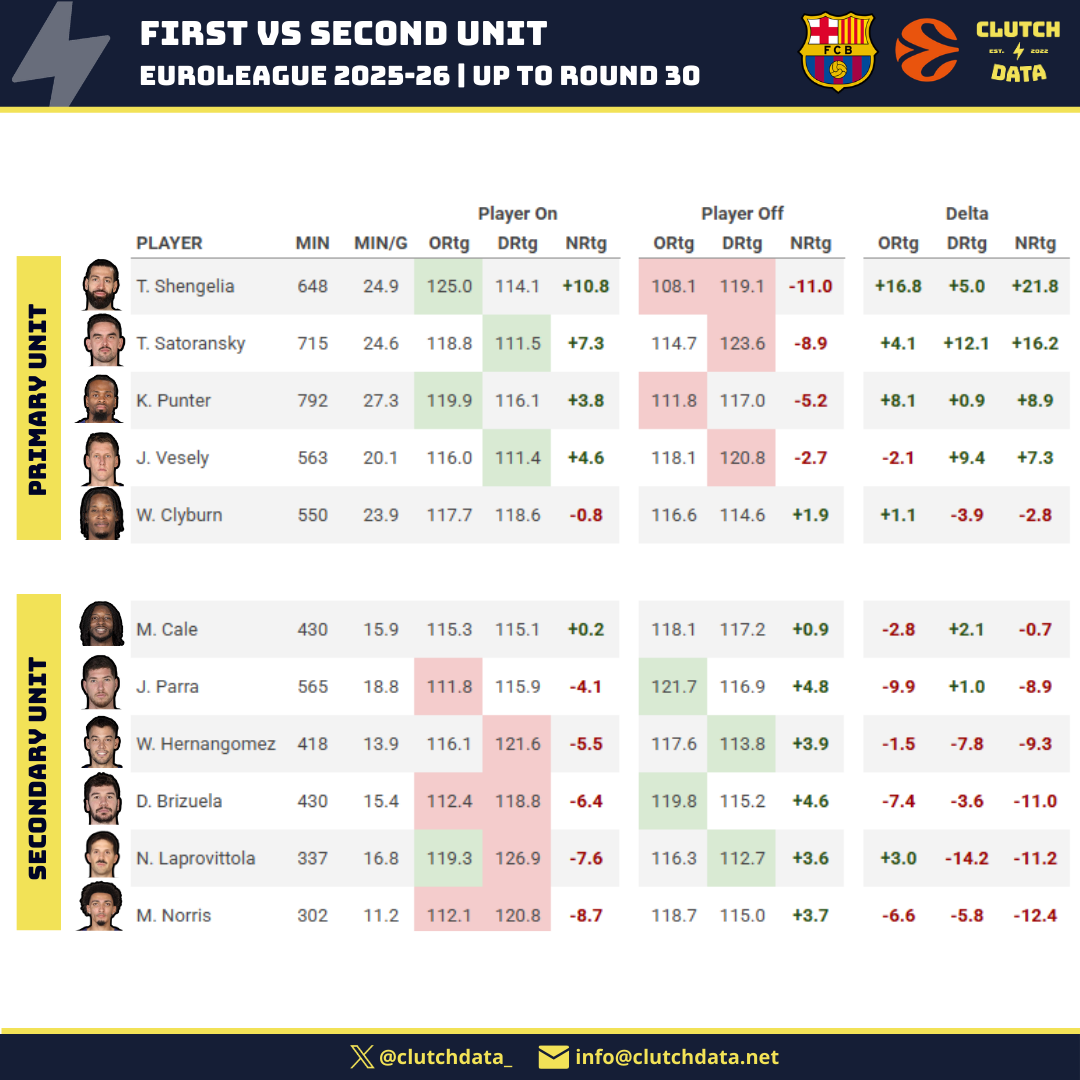
A deeper look at lineup data reveals one of the defining structural patterns of Barcelona’s season: the contrast between the primary unit and the secondary rotation.
Within the primary group, almost every player posts a positive Net Rating when on the floor, meaning Barcelona outscores opponents during their minutes. Interestingly, when those players sit, the team’s Net Rating often turns negative, suggesting that opponents gain ground when the core unit is off the court. The only exception is Clyburn. When he is on the floor, the team records a slightly negative Net Rating, largely driven by defensive struggles. Conversely, Barcelona performs slightly better when he is off the court.
The picture changes significantly when looking at the second unit. These lineups have struggled to match the impact of the starters, with the biggest drop-off appearing on the defensive end.
In particular, lineups featuring Hernangomez, Brizuela, Laprovittola or Norris tend to struggle defensively. Meanwhile, when Joel Parra is on the floor, the team’s offense tends to stagnate.
The only modest bright spot in the second unit is Cale, as Barcelona records a slightly positive Net Rating when he plays. However, even here the numbers remain mixed, as the team’s Net Rating becomes even better when he is off the court.
Overall, the data highlights a clear challenge: the gap between the impact of the starting group and the secondary rotation.
How the Right Combinations Can Unlock the Bench
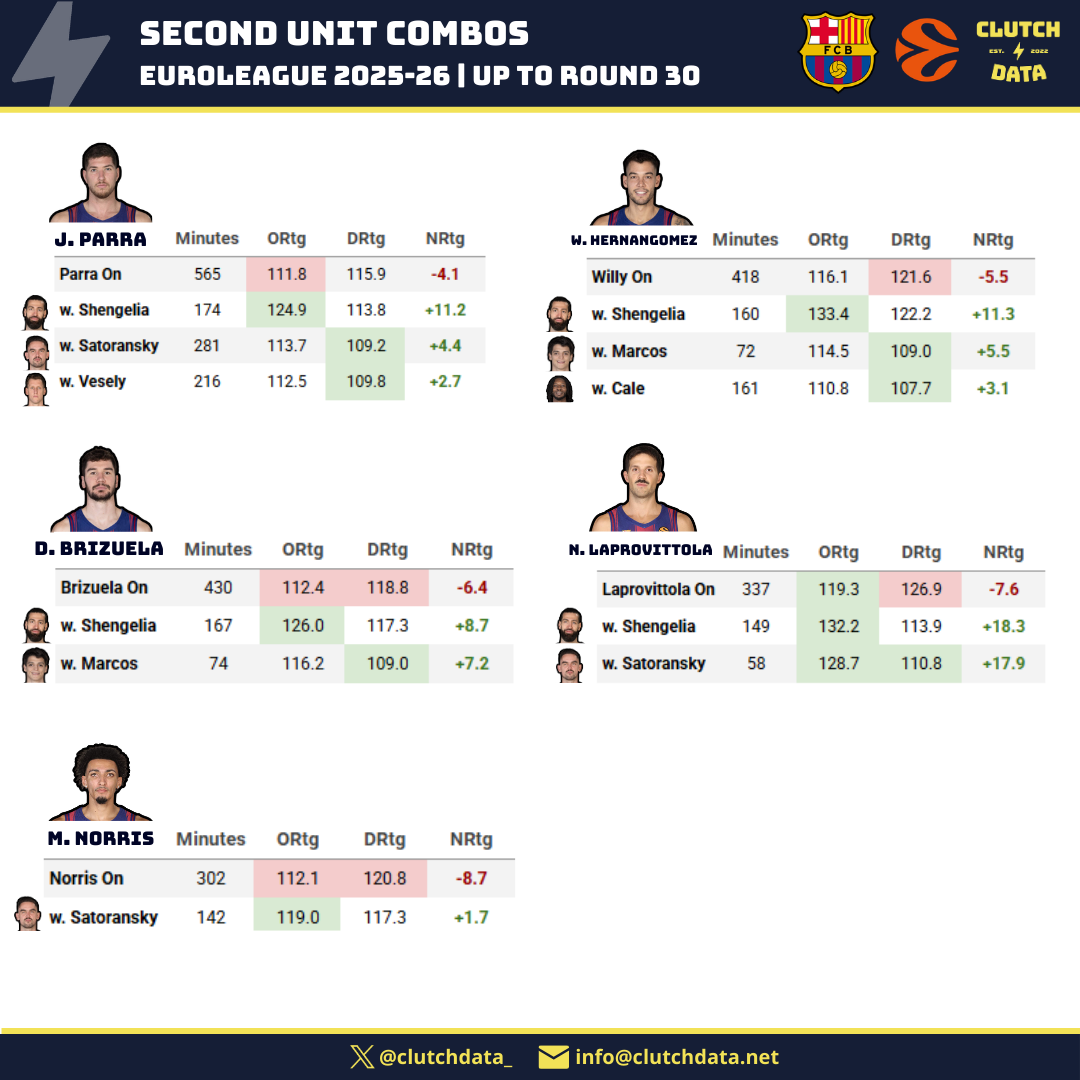
Despite the struggles of the second unit, lineup data also points toward potential solutions. When certain players are paired with complementary teammates, the secondary rotation becomes far more effective.
Joel Parra, for example, receives a major offensive boost when playing alongside Shengelia, while Satoransky and Vesely help stabilize the defense around him.
Hernangomez benefits defensively when sharing the floor with Marcos and Cale, while Shengelia once again lifts the offense in those lineups.
For Brizuela, the pattern is similar: Shengelia strengthens the offense, while Marcos improves the defensive stability around him.
Laprovittola finds support on both ends of the floor when paired with either Shengelia or Satoransky, giving the team more balance during his minutes.
Finally, Barcelona’s offense sees a noticeable jump when Morris shares the floor with Satoransky, another example of how the right combinations can stabilize the second unit.
These patterns reinforce an important takeaway: the bench’s effectiveness is less about individual talent and more about finding the right lineup balance.
Barcelona’s season has been shaped less by dramatic changes and more by a series of gradual adjustments. Offensively, the team has remained productive while slightly shifting its identity, playing at a slower pace, relying more on off-ball movement, and empowering isolation creators like Punter and Brizuela. Defensively, the numbers show a steady tightening. Opponents are shooting less efficiently, several playtypes have become harder to exploit, and subtle changes in pick-and-roll coverage have contributed to improved defensive outcomes. At the same time, the data also highlights two structural challenges that continue to define Barcelona’s season: the reliance on an experienced core and the gap between the primary unit and the secondary rotation. The encouraging sign is that the numbers already point toward potential solutions.
In that sense, Barcelona’s season is not simply a story of change, but of fine-tuning, a team gradually adjusting its tactics, rotations, and roles in search of the balance to make a final push for the playoffs.